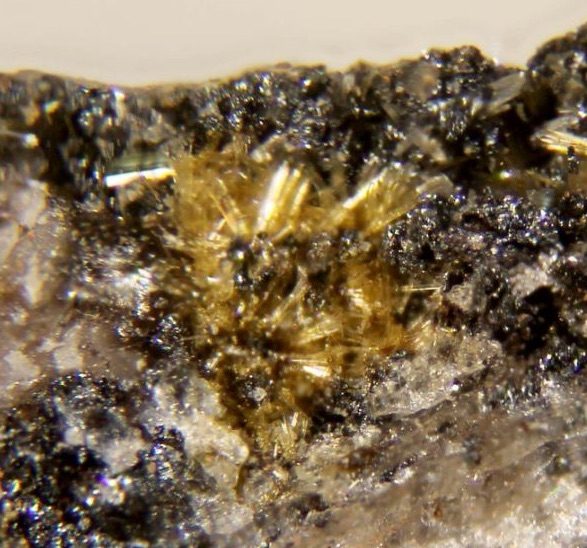
Outstanding acicular yellow crystals of the very rare Mn-phosphate mineral gatehouseite from the type locality (Iron Monarch Open Cut, Iron Knob, Middleback Range, Eyre Peninsula, South Australia, Australia) and only one of two known localities worldwide. Ex Vandenbroucke Museum collection specimen, from Waregem, Belgium. — Photo: David Hospital · CC BY-SA 4.0
Gatehouseite
A manganese hydroxyl phosphate discovered in 1987 and approved as a species in 1992.
Intro adapted from Wikipedia (CC BY-SA).
Gatehouseite is an IMA-recognized mineral species in the phosphate class, with the chemical formula Mn²⁺₅(PO₄)₂(OH)₄.
It crystallizes in the orthorhombic crystal system (space group P2_12_12_1). It is a member of the Arsenoclasite structural group.
Key properties: Mohs hardness 4; specific gravity 3.74; Pale yellow streak; Adamantine luster; refractive index 1.425; optically biaxial.
IMA symbol Ghs, IMA status: approved, named in 1992.
Found as a secondary mineral in cavities in a sedimentary Fe–Mn deposit, probably formed by reaction of phosphorus-rich fluids with hausmannite at low temperature.
It is found associated with Arsenoclasite, shigaite, hematite, hausmannite, triploidite, barite, manganoan ferroan calcite.
The mineral was named to honor Dr. Bryan Michael Kenneth Cummings Gatehouse (1932–), crystal chemist, Monash University, Melbourne, Australia.