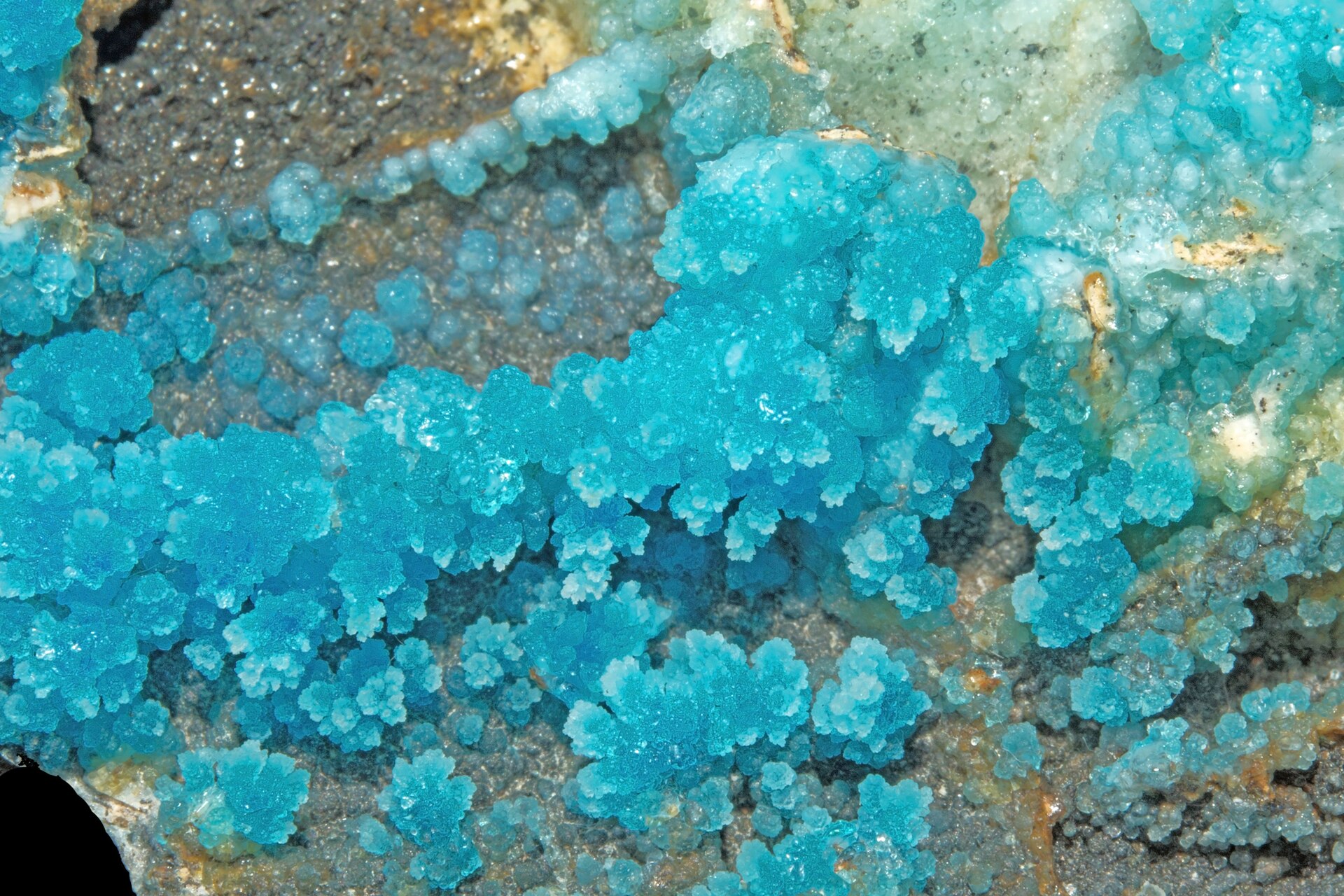
gibbsite : Hongsheke bauxite deposit, Yanshan Co., Wenshan Autonomus Prefecture, Yunnan province, China — Photo: Géry PARENT · CC BY-SA 4.0
Gibbsite
Also known as: Hydrargillite.
A principal form of aluminium hydroxide — the main aluminium mineral of bauxite, also called hydrargillite.
Intro adapted from Wikipedia (CC BY-SA).
Gibbsite is an IMA-recognized mineral species in the oxides & hydroxide class, with the chemical formula Al(OH)₃.
It crystallizes in the monoclinic crystal system (space group P2_1/n).
Key properties: Mohs hardness 2.5–3; specific gravity 2.4; typically white or colorless or gray; Vitreous, pearly on cleavage surfaces, dull in aggregates luster; optically biaxial.
IMA symbol Gbs, IMA status: approved, named in 1822.
A typical product of weathering of aluminous minerals, common in lateritic soils and bauxite. Also formed in low-temperature hydrothermal and metamorphic environments, replacing aluminous minerals.
It is found associated with Diaspore, böhmite, corundum, kaolinite, goethite.
The mineral was named to honor Colonel George Gibbs (1776–1833), a prominent mineral collector of New Haven, Connecticut, USA.
Collections: Everyday Minerals.