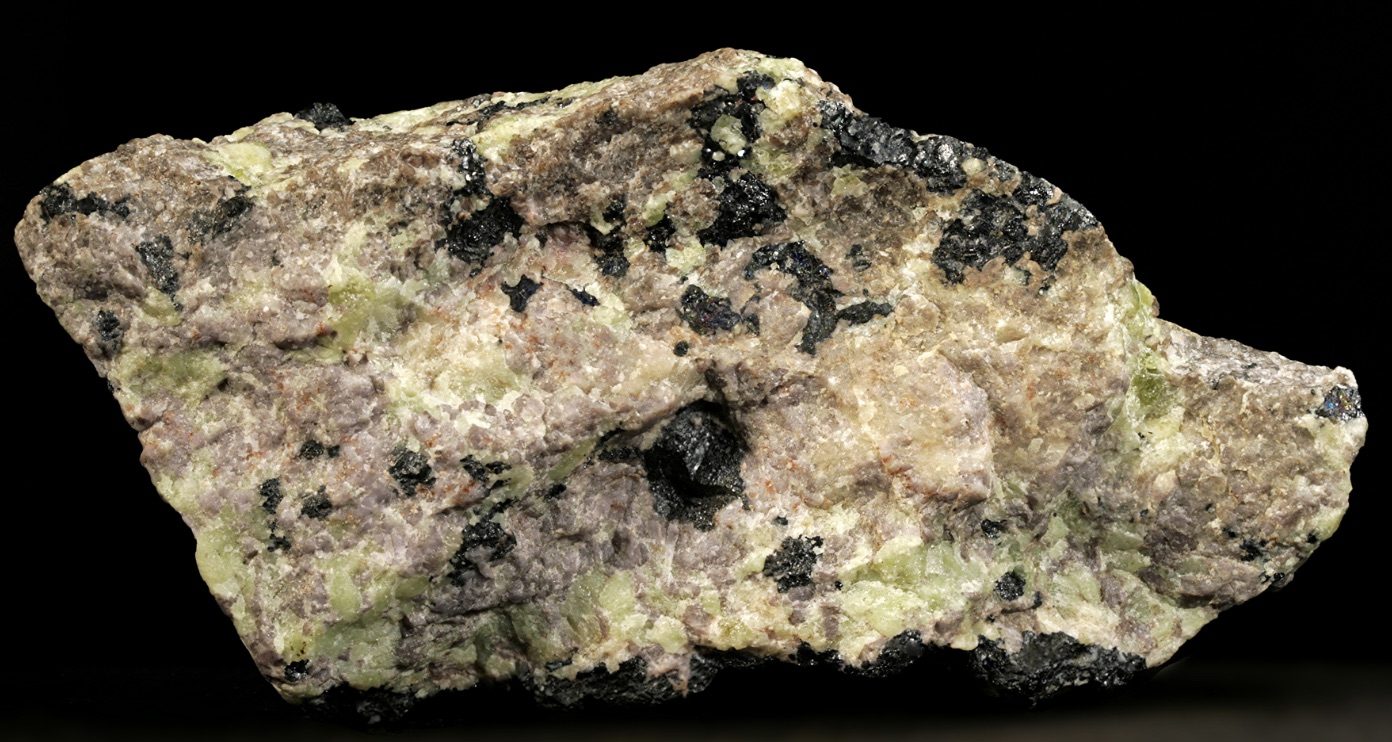
Glaucochroite Locality: Franklin Mine, Franklin, Franklin Mining District, Sussex Co., New Jersey, USA Description: This is a child photo. Previous (not too useful) stereo image replaced Dec 2012 with a full res image using a dark background. Under these conditions, the glaucochroite looks quite pinkish. But it looks pale blue in daylight or under CFL. — Photo: Modris Baum · Public domain
Glaucochroite
A calcium-manganese nesosilicate of metamorphosed limestone, described in 1899 from Franklin Furnace, New Jersey.
Intro adapted from Wikipedia (CC BY-SA).
Glaucochroite is an IMA-recognized mineral species in the silicate class, with the chemical formula CaMn²⁺(SiO₄).
It crystallizes in the orthorhombic crystal system (space group Pbnm). It is a member of the Olivine structural group.
Key properties: Mohs hardness 6; specific gravity 3.407; Vitreous luster; optically biaxial.
IMA symbol Glc, grandfathered status — known before the IMA’s founding, named in 1899.
Found in a metamorphosed stratiform zinc deposit (Franklin, New Jersey, USA); in skarn at the contact between diabase and marble (Anakit Creek, Russia); in calc-silicate rocks with manganese ores (Kuruman, South Africa).
It is found associated with Nasonite, willemite, andradite, hardystonite, tephroite, clinohedrite, esperite, leucophoenicite, hodgkinsonite, diopside, cuspidine, calcite, franklinite.
Its name comes from the Greek for blue green and color, in allusion to its color.