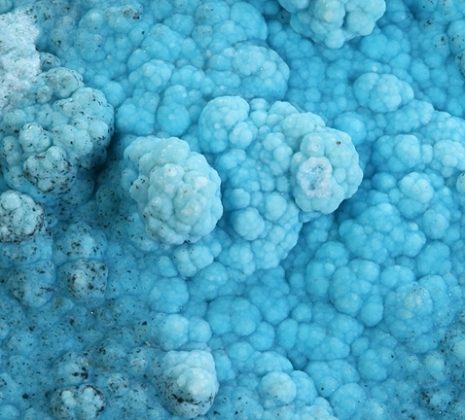
Glaucocerinite (Size: 7.7 x 5.2 x 1.8 cm) Locality: Lavrion (Laurion; Laurium) , Lavrion District Mines, Lavrion (Laurion; Laurium) District, Attikí (Attica; Attika) Prefecture, Greece ( Locality at mindat.org ) Glaucocerinite is a fairly rare zinc copper aluminum sulfate that is only found in a handful of worldwide localities. The mineral is known for it's amazingly beautiful blue hues, which makes sense since it's name is derived from the word Glaucous (the Latin glaucus means "bluish-grey or green", and the Greek glaukos is used to describe the pale grey or bluish-green appearance of the surfaces of some plants). Laurion is the most well-known locality for this mineral, along with being the type locality. This piece is an excellent Glaucocerinite featuring dozens of small greenish-blue botryoids on matrix. — Photo: Robert M. Lavinsky · CC BY-SA 3.0
Glaucocerinite
Glaucocerinite is an IMA-recognized mineral species in the sulfate class, with the chemical formula (Zn₁₋ₓAlₓ)(SO₄)ₓ/₂(OH)₂·nH₂O (x 3x/2).
It crystallizes in the hexagonal crystal system. It is a member of the Woodwardite, Hydrotalcite structural group.
Key properties: Mohs hardness 1; specific gravity 2.4; Waxy luster.
IMA symbol Gc, grandfathered status — known before the IMA’s founding, named in 1932.
A rare secondary mineral on museum specimens from a Cu–Zn sulfide deposit.
It is found associated with Smithsonite, adamite, ktenasite, serpierite, malachite, azurite, gypsum, pyrite, galena, sphalerite, fluorite, calcite, “limonite”.
Its name comes from the Greek for bluish green and waxlike.