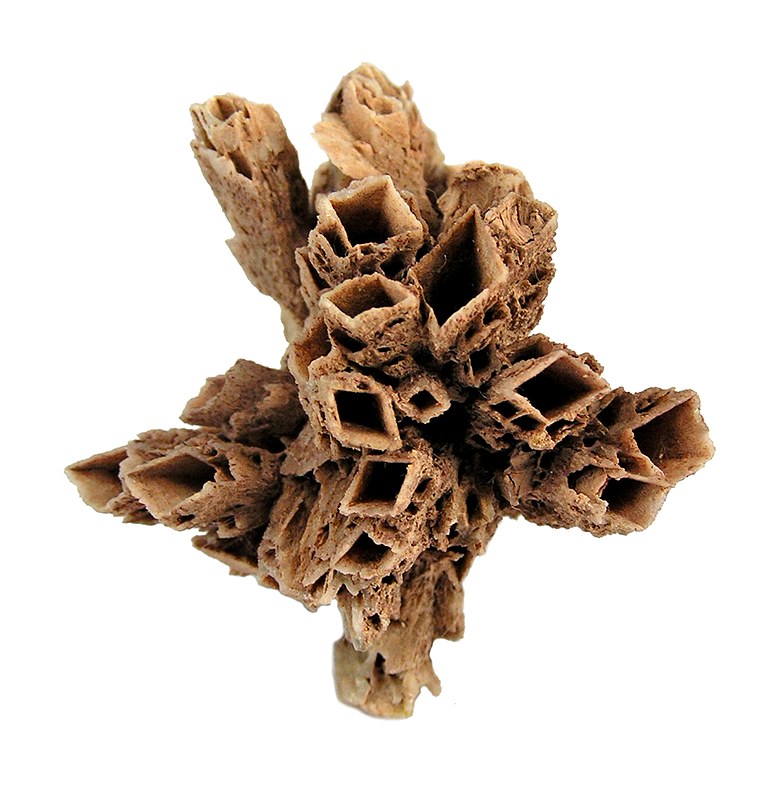
Glauberite, Quartz Locality: Little Falls, New Jersey Size: miniature, 4.6 x 4.3 x 2.8 cm Quartz pseudo. after Glauberite What was once a flower-like cluster of — Photo: Robert M. Lavinsky · CC BY-SA 3.0
Glauberite
A monoclinic sodium-calcium sulfate described in 1808 from Spain — a common evaporite mineral.
Intro adapted from Wikipedia (CC BY-SA).
Glauberite is an IMA-recognized mineral species in the sulfate class, with the chemical formula Na₂Ca(SO₄)₂.
It crystallizes in the monoclinic crystal system (space group C2/c).
Key properties: Mohs hardness 2.5–3; specific gravity 2.75–2.85; typically white or gray or yellow or colorless; White streak; Vitreous to waxy, pearly on {001} cleavage surfaces luster; refractive index 1.525; optically biaxial.
IMA symbol Glb, grandfathered status — known before the IMA’s founding, named in 1808.
A common constituent of continental and marine evaporite deposits; as sublimates around fumaroles; in mineral-filled cavities in basaltic lava; in nitrate deposits in arid climates.
It is found associated with Halite, polyhalite, anhydrite, gypsum, thénardite, mirabilite (evaporites); thénardite, sassolite (fumaroles); thénardite, blödite (nitrate deposits).
In allusion to Glauber’s Salt (Na2 SO4), the synthetic equivalent of the dominant chemical component, named for Johann Rudolf Glauber (1604–1668), German alchemist.
Collections: Collector Favorites.