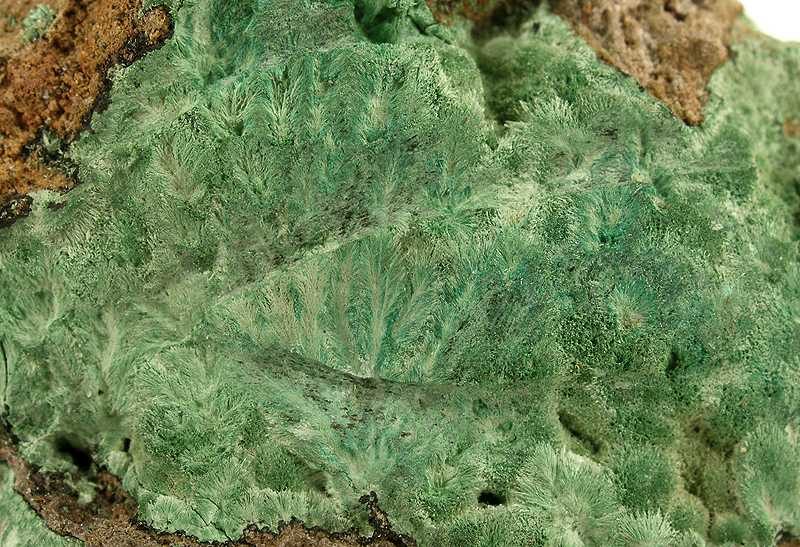
Glaukosphaerite Locality: Kasompi Mine (Menda Mine; Kasompi Hill), Swambo, Central area, Katanga Copper Crescent, Katanga (Shaba) , Democratic Republic of Congo (Zaïre) ( Locality at mindat.org ) Size: small cabinet, 6.2 x 3.6 x 2.6 cm Glaukosphaerite Kasompiite, as shown on the accompanying label, was the old name given to material from this mine now known to be the already named mineral species Glaukosphaerite. This is a rare copper-nickel carbonate, and few deposits produce beautiful examples. This is a large, attractive, velvety looking specimen rich with mattes of the mineral on gangue matrix. It has a noticeable bit too much heft for malachite. But, it looks like velvety malachite on first glance. Ex. John White Collection. — Photo: Robert M. Lavinsky · CC BY-SA 3.0
Glaukosphaerite
Glaukosphaerite is an IMA-recognized mineral species in the carbonate class, with the chemical formula CuNi(CO₃)(OH)₂.
It crystallizes in the monoclinic crystal system (space group P2_1/a). It is a member of the Malachite structural group.
Key properties: Mohs hardness 3–4; specific gravity 3.78–3.96; Pale green streak; Subvitreous to dull, silky if fibrous luster; optically biaxial.
IMA symbol Gks, IMA status: approved, named in 1972.
A rare secondary mineral found in the oxidized portions of Cu–Ni sulfide deposits.
It is found associated with Nickeloan malachite, azurite, paratacamite, brochantite, chalconatronite, takovite, georgeite, carrboydite, gaspéite, népouite, nickeloan chrysotile.
Its name comes from the Greek for bluish green and spherical, the typical color and habit.