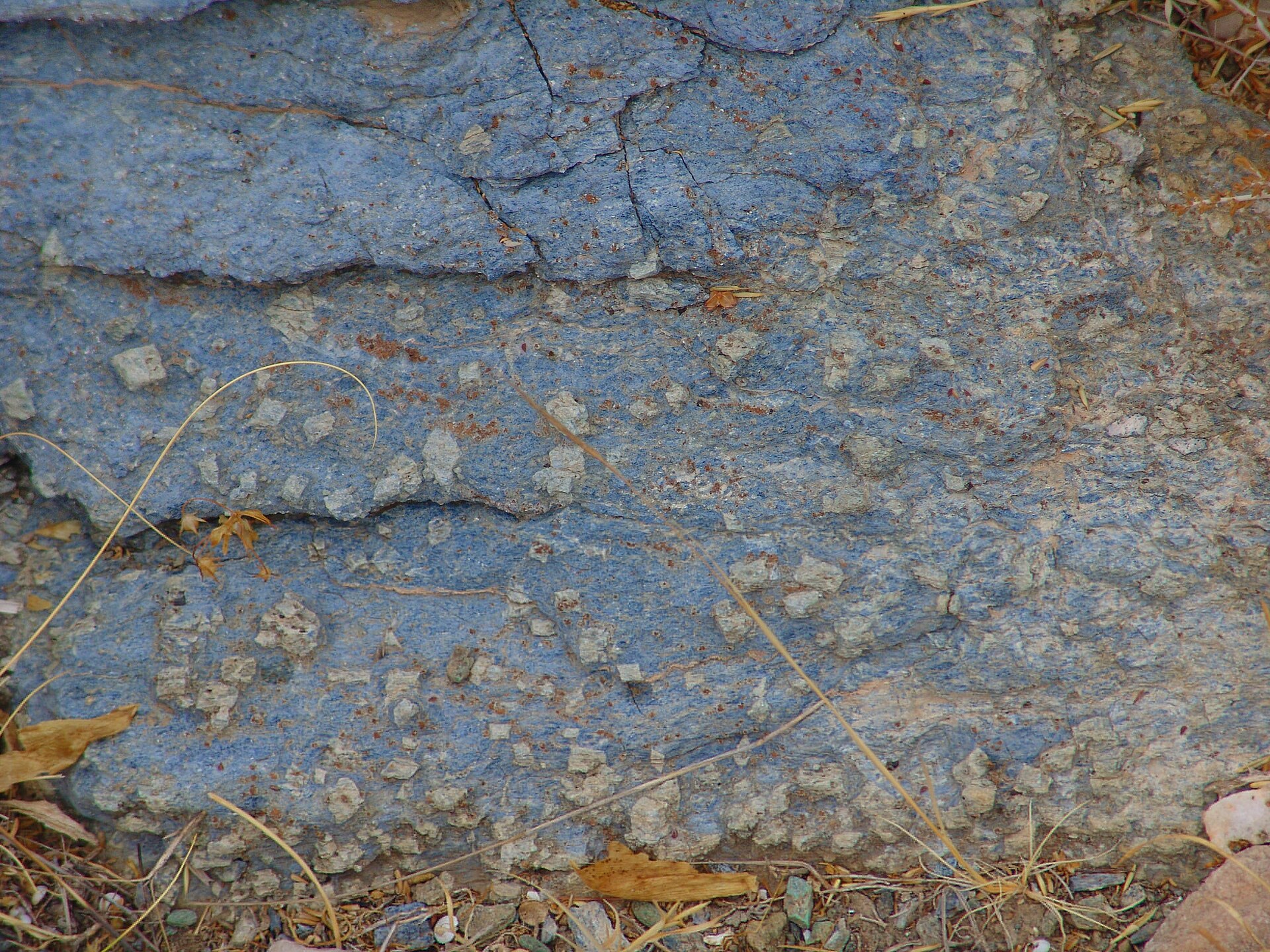
Glaucophane lawsonite schist on Syros in Greece. Lawsonite crystals (light coloured) are porphyroblasts in a groundmass of blue glaucophane crystals. — Photo: Graeme Churchard (GOC53) https://www.flickr.com/people/graeme/ · CC BY 2.0
Glaucophane
Also known as: Blue amphibole.
The sodic amphibole that lends blueschist its color — a blue monoclinic inosilicate of high-pressure, low-temperature metamorphic rocks.
Intro adapted from Wikipedia (CC BY-SA).
Glaucophane is an IMA-recognized mineral species in the silicate class, with the chemical formula Na₂(Mg₃Al₂)Si₈O₂₂(OH)₂.
It crystallizes in the monoclinic crystal system (space group C2/m). It is a member of the Amphibole structural group.
Key properties: Mohs hardness 6–6.5; specific gravity 3.08–3.22; typically blue or gray or black; Blue-gray streak; Vitreous to pearly luster; refractive index 1.632; optically biaxial.
IMA symbol Gln, IMA status: approved, named in 1845.
Characteristic of the blueschist facies, in former subduction zones in mountain belts; in the greenschist facies and in eclogites that have undergone retrograde metamorphism.
It is found associated with Crossite, chlorite, epidote, pumpellyite, lawsonite, omphacite, jadeite, actinolite, barroisite, cummingtonite, aragonite.
Its name comes from the Greek for bluish green and to appear.
Collections: Collector Favorites.