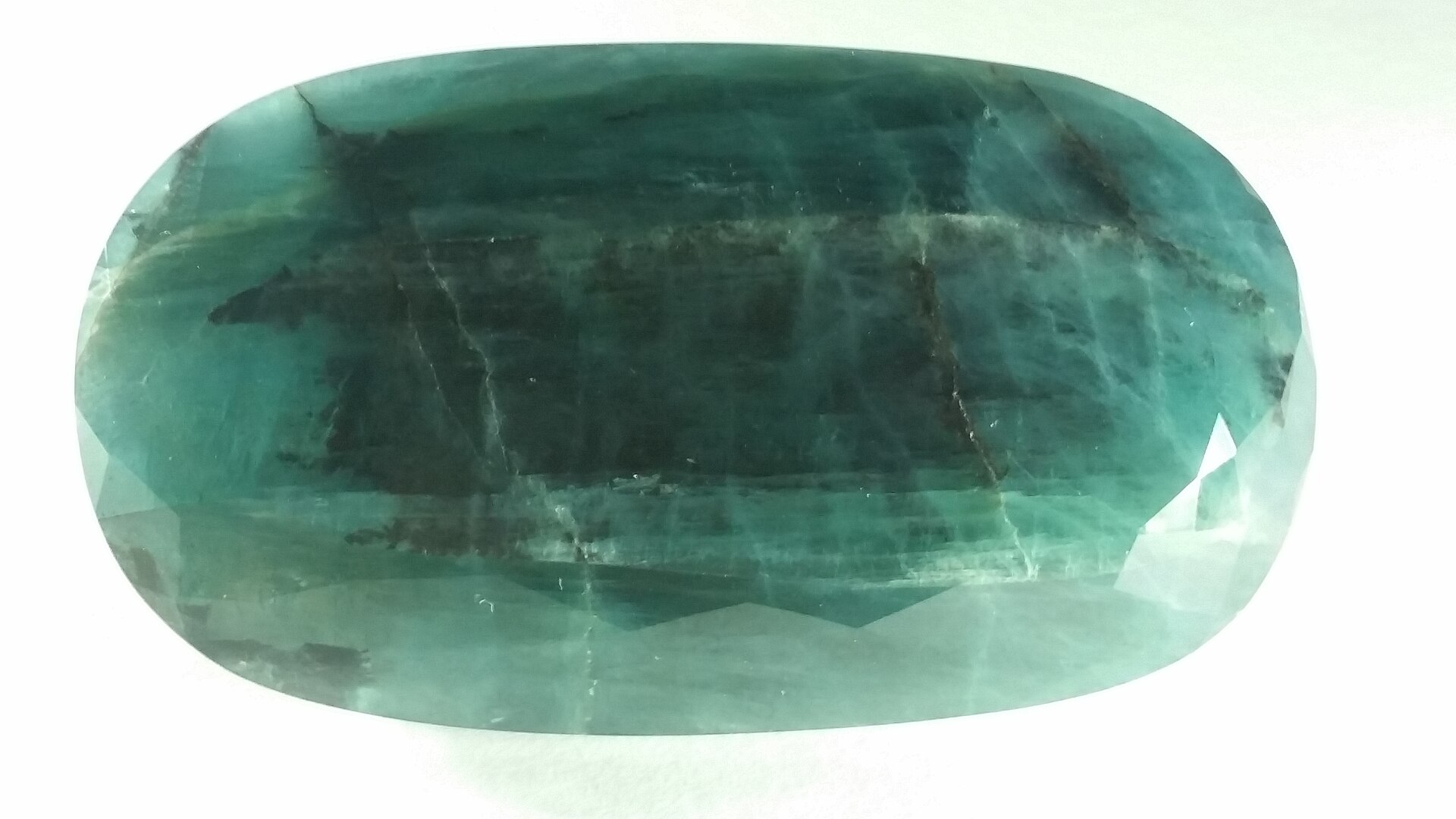
World's Largest Cut Grandidierite 429.87 Carats Grandidierite Owned By a Filipino collector Benedicto G. Membrere V — Photo: Gmerritt · CC BY-SA 4.0
Grandidierite
A rare bluish-green magnesium borosilicate discovered in Madagascar in 1902 — a sought-after collector's gem named for explorer Alfred Grandidier.
Intro adapted from Wikipedia (CC BY-SA).
Grandidierite is an IMA-recognized mineral species in the silicate class, with the chemical formula MgAl₃O₂(BO₃)(SiO₄).
It crystallizes in the orthorhombic crystal system (space group Pbnm).
Key properties: Mohs hardness 7.5; specific gravity 2.98–2.99; typically blue or green; white streak; Vitreous, somewhat pearly on the cleavage luster; refractive index 1.611; optically biaxial.
IMA symbol Gdd, grandfathered status — known before the IMA’s founding, named in 1902.
Found as a rare accessory mineral in aluminous boron-rich rocks, thermally and high-grade regionally metamorphosed under low pressure; in pegmatites, aplites, gneisses; in xenoliths.
It is found associated with Quartz, potassic feldspar, plagioclase, biotite, garnet, \hypersthene, " spinel, corundum, sillimanite, andalusite, cordierite, tourmaline, kornerupine.
The name refers to Alfred Grandidier (1836–1912), French naturalist and explorer, an authority on Madagascar.
Collections: Gemstones, Rare & Remarkable.