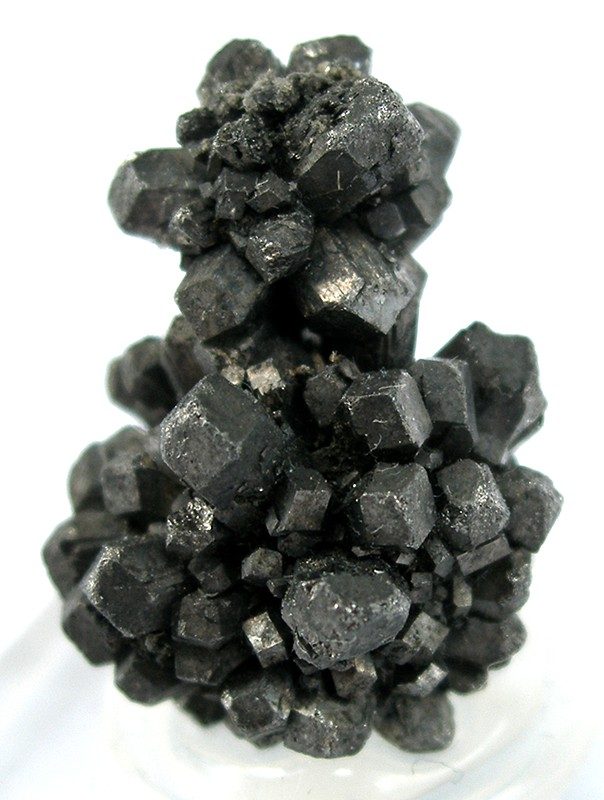
Gratonite Locality: Excelsior Mine, Cerro de Pasco , Daniel Alcides Carrión Province , Pasco Department, Peru ( Locality at mindat.org ) Size: thumbnail, 2.2 x 1.2 x 1.2 cm Gratonite I must say that this is one of the most aesthetic gratonite specimens I have seen. They are truly rare on the market, having come out mostly in the 1930s (or perhaps only then - I often hear of a few small finds dating to that time, and have heard of no more since). The overall doublet or hourglass form is spectacular, made up of individual crystals to 2.5 mm across in radiating rosettes. What is nice is that this is a full sized thumbnail tha tis more than the usual stubby lump with pokey crystals...it actually has some elegance. A truly competition quality thumbnail, gratonite is a rare lead, arsenic, sulfide. This specimen is also from the type locality. — Photo: Robert M. Lavinsky · CC BY-SA 3.0
Gratonite
A lead-arsenic sulfosalt — the low-temperature dimorph of jordanite — discovered in 1939 at Cerro de Pasco, Peru.
Intro adapted from Wikipedia (CC BY-SA).
Gratonite is an IMA-recognized mineral species in the sulfosalt class, with the chemical formula Pb₉As₄S₁₅.
It crystallizes in the hexagonal crystal system (space group R3m).
Key properties: Mohs hardness 2.5; specific gravity 6.22; Black streak; Metallic luster.
IMA symbol Gtn, grandfathered status — known before the IMA’s founding, named in 1939.
Found in vugs in hydrothermal copper ores.
It is found associated with Realgar, pyrite, sphalerite, pyrrhotite, arsenopyrite, enargite, tetrahedrite– tennantite, jordanite, canfieldite, hutchinsonite.
In honor of Louis Caryl Graton (1880–1970), Professor of Mining Geology, Harvard University, Cambridge, Massachusetts, USA.