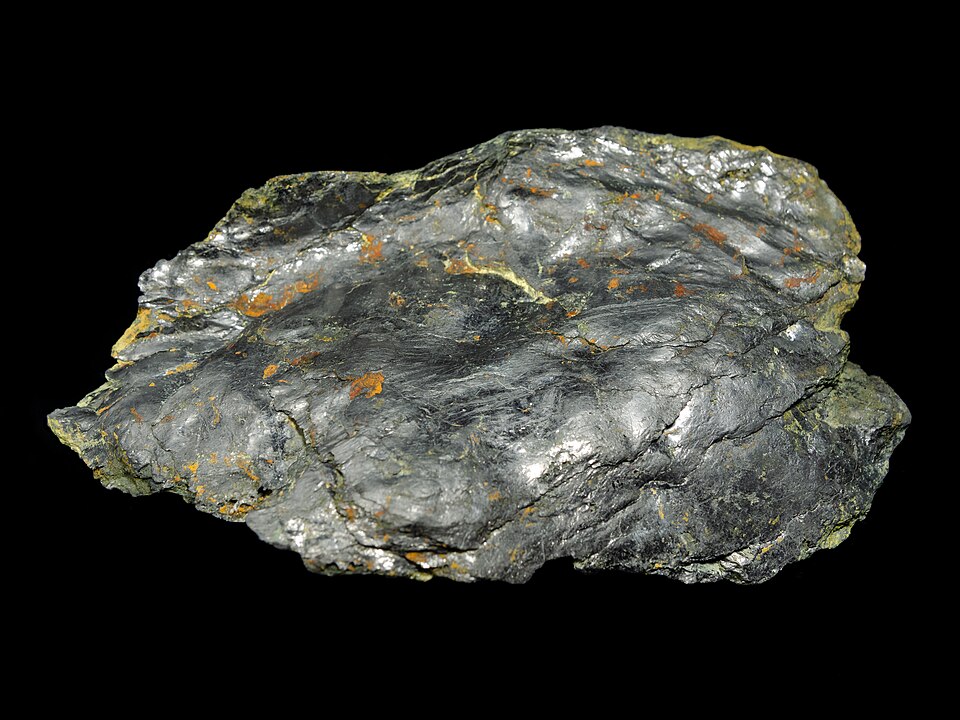
Pure graphite specimen from abandoned graphite mines near Velké Tresné, Czech Republic. — Photo: Zbynek Burival · CC Attribution-Share Alike 4.0 International
Graphite
Also known as: Plumbago, Black lead.
The soft, layered allotrope of carbon — the most stable form of carbon at surface conditions, and the 'lead' in pencils.
Intro adapted from Wikipedia (CC BY-SA).
Graphite is an IMA-recognized mineral species in the native element class, with the chemical formula C.
It crystallizes in the orthorhombic crystal system (space group P6_3mc).
Key properties: Mohs hardness 1–2; specific gravity 2.09–2.23; typically gray or black; Black to steel-gray, shining streak; Metallic; may be dull, earthy luster; optically uniaxial.
IMA symbol Gr, grandfathered status — known before the IMA’s founding, named in 1789.
Formed by metamorphism of sedimentary carbonaceous material, by the reduction of carbon compounds; a primary constituent in igneous rocks.
It is found associated with A wide variety of minerals stable in the metamorphic conditions under which graphite forms. In meteorites, in nodules with troilite, silicates.
Its name comes from the Greek to write, in allusion to its use as a crayon.
Collections: Everyday Minerals.