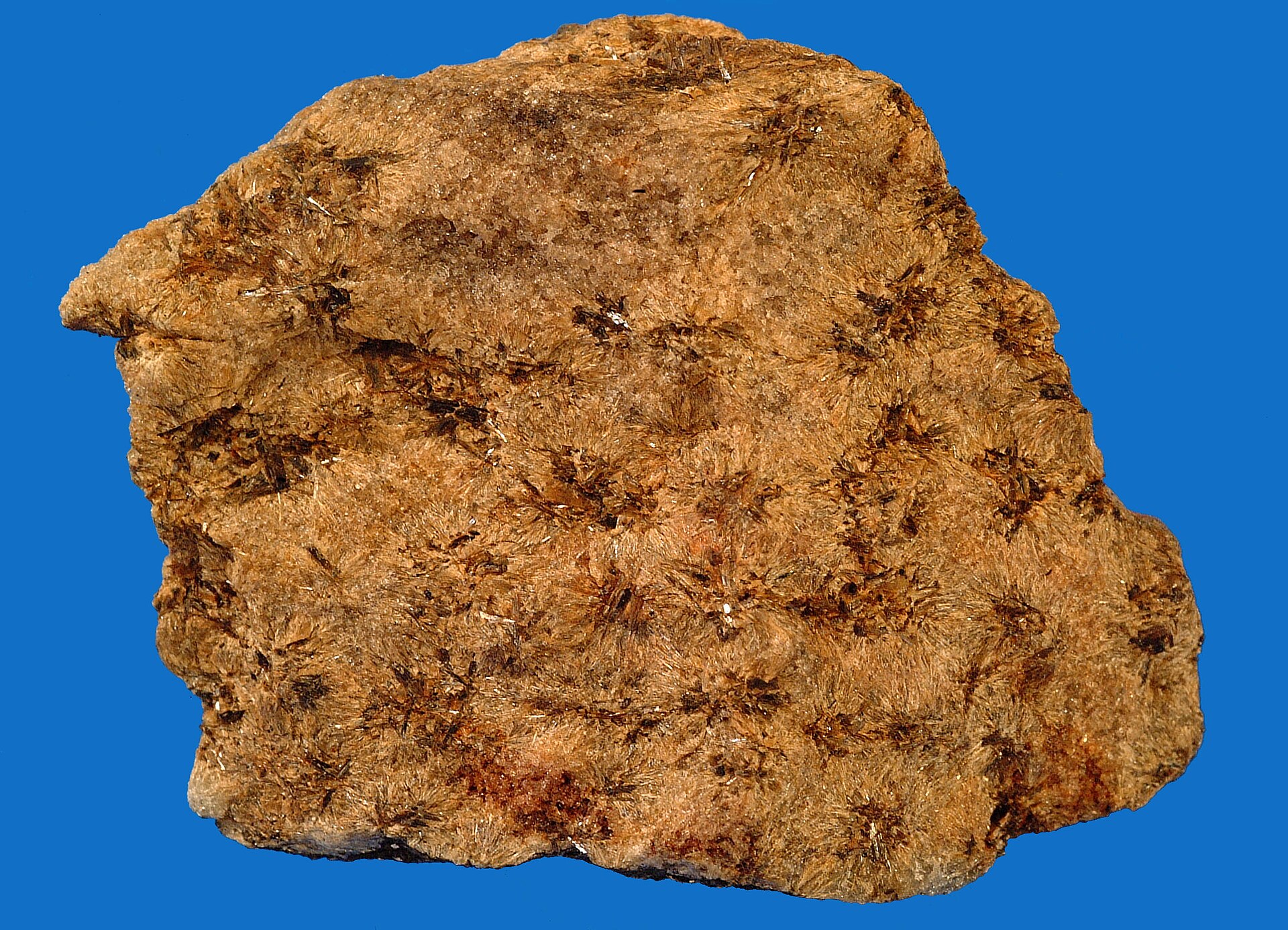
Grunerite is member of the amphibole group. It has the chemical formula of Fe7(Si8O22)(OH)2. When it is asbestiform (formed as fine asbestos needles and threads — Photo: Shannon Heinle · CC0
Grunerite
Also known as: Amosite (fibrous var.).
The iron end-member of the grunerite-cummingtonite amphibole series — a fibrous iron silicate of metamorphosed iron formations.
Intro adapted from Wikipedia (CC BY-SA).
Grunerite is an IMA-recognized mineral species in the silicate class, with the chemical formula Fe²⁺₂Fe²⁺₅Si₈O₂₂(OH)₂.
It crystallizes in the monoclinic crystal system (space group C2/m). It is a member of the Amphibole structural group.
Key properties: Mohs hardness 5–6; specific gravity 3.4–3.6; typically brown or gray or green; white streak; Vitreous, silky when fibrous luster; optically biaxial.
IMA symbol Gru, IMA status: approved, named in 1853.
Common in medium- to high-grade metamorphosed iron formations. A product of contact metamorphism, and in some blueschist facies metaquartzites.
It is found associated with Magnetite, hematite, hedenbergite, riebeckite, fayalite, garnet, quartz.
The mineral was named to honor the French chemist, Louis Emmanuel Gruner (1809–1883), who provided the first analysis. All rights reserved. No part of this publication may be reproduced.
Collections: Collector Favorites.