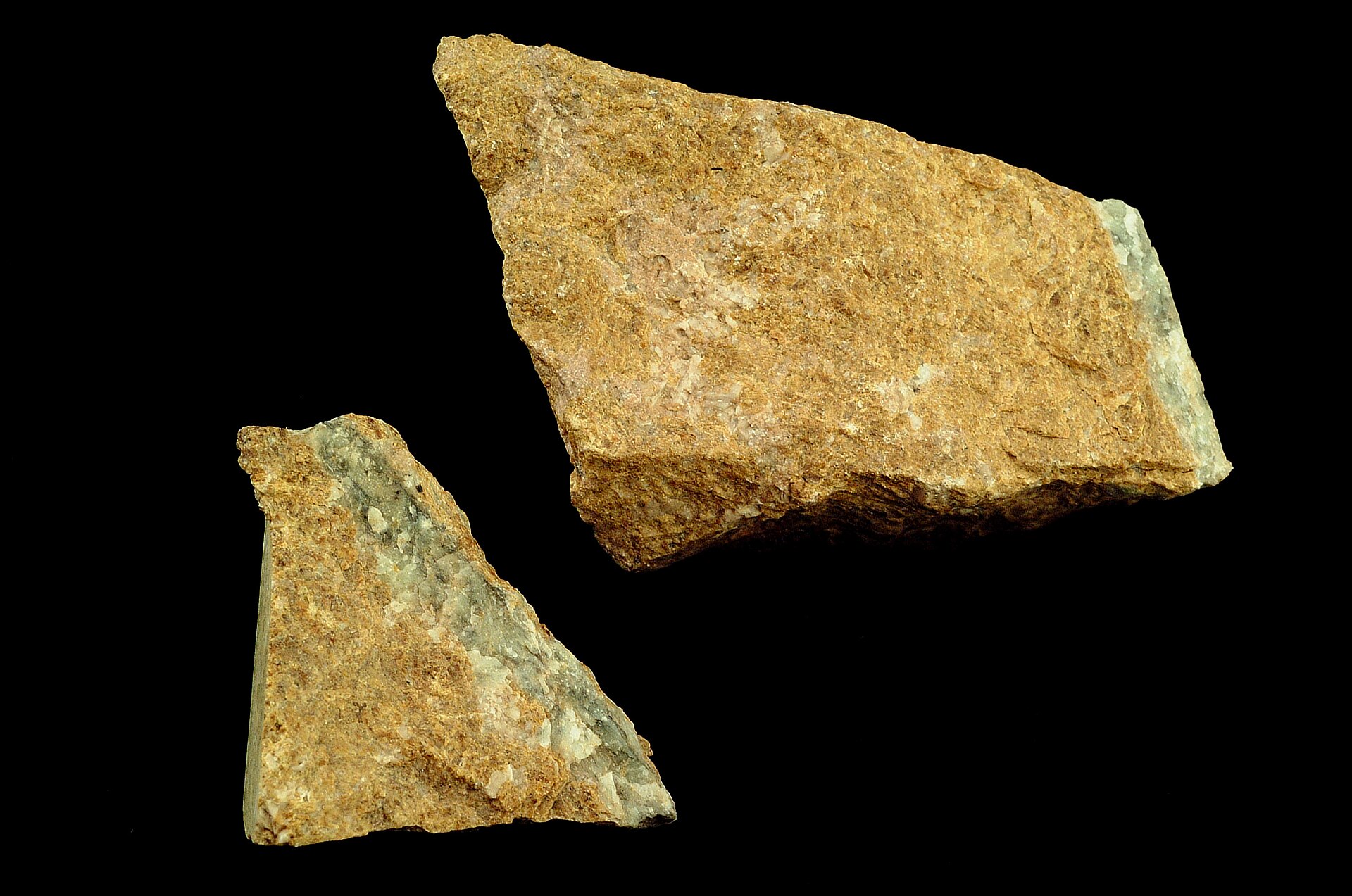
These samples from Franklin, New Jersey, USA are mostly brown hardystonite Ca2ZnSi2O7 with lighter colored veins of willemite, Zn2SiO4. Hardystonite is a rare m — Photo: Nessa Eull · CC0
Hardystonite
A rare calcium-zinc silicate first described at Franklin, New Jersey — famous for its deep-violet fluorescence under UV.
Intro adapted from Wikipedia (CC BY-SA).
Hardystonite is an IMA-recognized mineral species in the silicate class, with the chemical formula Ca₂ZnSi₂O₇.
It crystallizes in the tetragonal crystal system (space group P-42_1m). It is a member of the Melilite structural group.
Key properties: Mohs hardness 4; specific gravity 3.4–3.44; typically white or gray; white streak; Vitreous luster; refractive index 1.667; optically uniaxial.
IMA symbol Hdy, grandfathered status — known before the IMA’s founding, named in 1899.
Found in granular ore in a metamorphosed stratiform zinc deposit.
It is found associated with Vesuvianite, apatite, franklinite, willemite, rhodonite, calcite, dolomite.
The name refers to Hardyston Township in which Franklin is situated.
Collections: Collector Favorites, Rare & Remarkable, Fluorescent & Glowing.