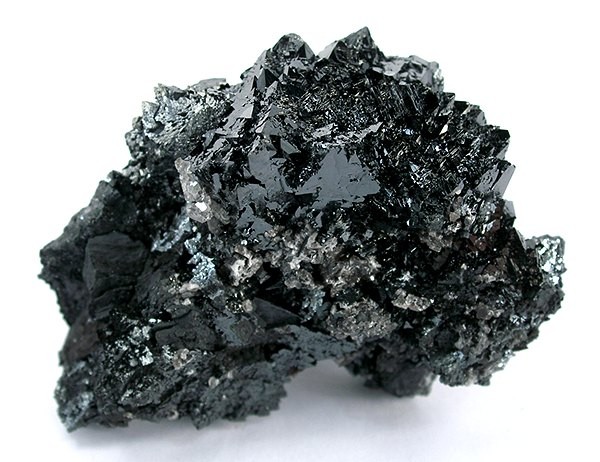
Hausmannite crystals, Wessels Mine, Kalahari manganese field, South Africa. — Photo: Robert M. Lavinsky · CC BY-SA 3.0
Hausmannite
A mixed-valence manganese oxide — the manganese counterpart of magnetite — forming lustrous brownish-black tetragonal crystals.
Intro adapted from Wikipedia (CC BY-SA).
Hausmannite is an IMA-recognized mineral species in the oxides & hydroxide class, with the chemical formula Mn²⁺Mn³⁺₂O₄.
It crystallizes in the tetragonal crystal system (space group I4_1/amd). It is a member of the Spinel structural group.
Key properties: Mohs hardness 5.5; specific gravity 4.84; typically brown or black; Dark reddish brown streak; Submetallic luster; refractive index 2.31; optically uniaxial.
IMA symbol Hsm, grandfathered status — known before the IMA’s founding, named in 1828.
Found as a primary mineral in hydrothermal veins. Also produced by metamorphism of manganiferous rocks.
It is found associated with Rhodochrosite, pyrolusite, jacobsite, braunite, andradite, barite.
The mineral was named to honor Johan Friedrich Ludwig Hausmann (1782–1859), Professor of Mineralogy, University of Göttingen, Göttingen, Germany.
Collections: Collector Favorites.