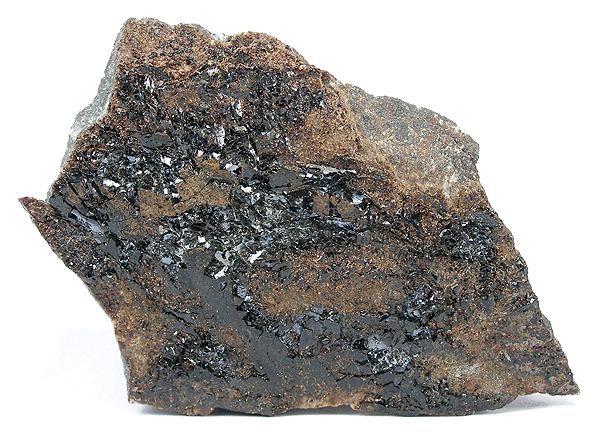
Hisingerite Locality: Långban , Filipstad , Värmland , Sweden ( Locality at mindat.org ) Size: 7.3 x 5.2 x 2.4 cm. Hisingerite is an uncommon secondary, hydrated, iron silicate. Very rare, crystallized plates of reddish-brown, silver metallic-lustre hisingerite crystals are festooned on the sculptural matrix of this very rich specimen from the famous Langban deposit of Sweden. Hisingerite specimens are very rare from Langban and this choice piece is from the collection of Dr. Mark Feinglos, a noted rarities collector. — Photo: Robert M. Lavinsky · CC BY-SA 3.0
Hisingerite
A black lustrous ferric-iron phyllosilicate formed by weathering of iron silicates and sulfides.
Intro adapted from Wikipedia (CC BY-SA).
Hisingerite is an IMA-recognized mineral species in the silicate class, with the chemical formula Fe₂Si₂O₅(OH)₄·2H₂O.
It is a member of the Clay, Kaolinite structural group.
Key properties: Mohs hardness 2.5–3; specific gravity 2.43–2.67; Yellowish brown streak; Resinous, vitreous, greasy luster.
IMA symbol Hsg, grandfathered status — known before the IMA’s founding, named in 1819.
A secondary mineral, formed from the weathering, or late-stage deuteric or hydrothermal alteration, of iron-bearing silicates or sulfides; by late-stage hydrothermal activity during sulfide ore deposition.
It is found associated with Olivine, pyroxene, pyrite, chalcopyrite, pyrrhotite.
The name refers to the Swedish chemist and mineralogist, Vilhelm Hisinger (1766–1852).