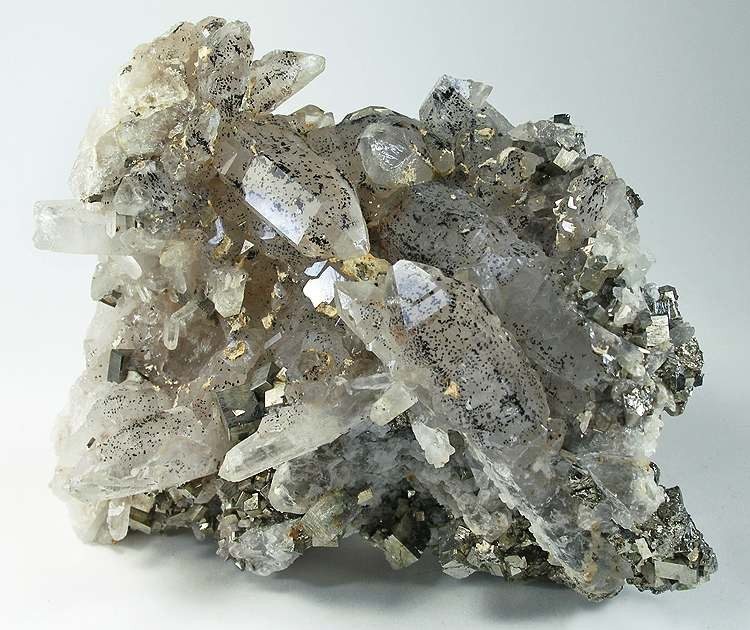
Quartz , Hubeite , Pyrite Locality: Ezhou Prefecture, Hubei Province , China ( Locality at mindat.org ) Size: 14.4 x 12.9 x 6.9 cm. A large, ornate and quite unusual Chinese specimen out of the J.R. Glover Collection. The quartz crystals contain little black inclusions of hubeite, a strange sorosilicate mineral only recently identified (found first at the Daye Mine, also in Hubei Province, and named after this province). At some point the quartz crystals here were sprinkled with these little black hubeites, and then growth continued, so they are now enclosed under thin sheet of quartz (rather than being on the surface of the crystals) as inclusions. Shiny golden pyrite adds an attractive accent to the specimen. — Photo: Robert M. Lavinsky · CC BY-SA 3.0
Hubeite
A sorosilicate with the unusual Si₄O₁₃ group, found in and named for China's Hubei province.
Intro adapted from Wikipedia (CC BY-SA).
Hubeite is an IMA-recognized mineral species in the silicate class, with the chemical formula Ca₂Mn²⁺Fe³⁺Si₄O₁₂(OH)·2H₂O.
It crystallizes in the triclinic crystal system (space group P1).
Key properties: Mohs hardness 5.5; specific gravity 3.02; Pale orange-brown streak; Vitreous luster; refractive index 1.679; optically biaxial.
IMA symbol Hub, IMA status: approved, named in 2000.
Found in a skarn assemblage.
It is found associated with Inesite, natroapophyllite-fluorapophyllite, quartz, pyrite, calcite.
The name refers to the province in China where the first specimens were collected.