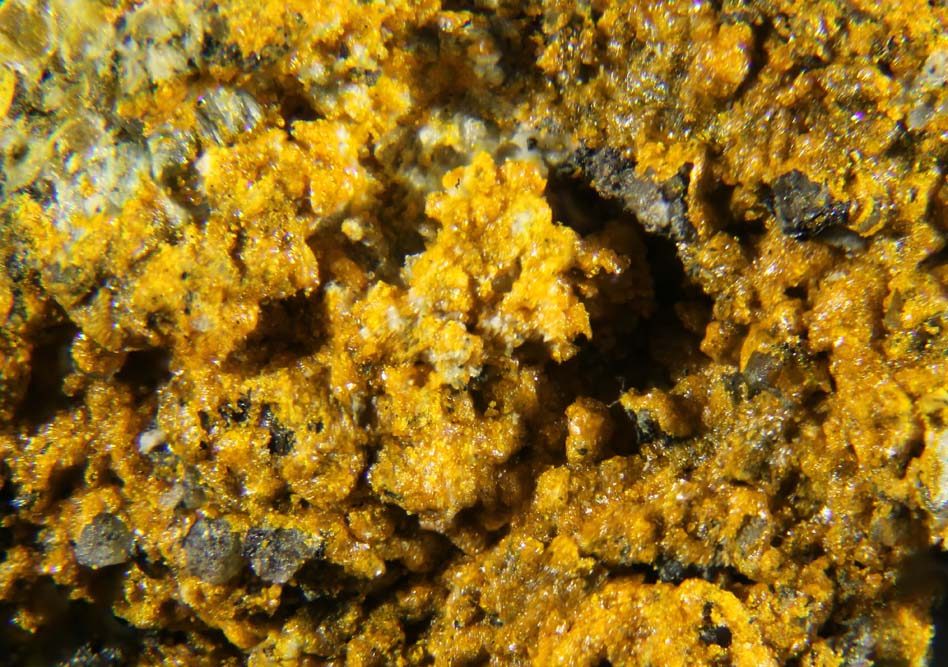
Deep orange crystals of the rare vanadium mineral huemulite on a dark contrasting matrix. From: Sunday Mine, Slick Rock District, San Miguel Count, Colorado, United States of America. — Photo: David Hospital · CC BY-SA 4.0
Huemulite
A yellow-to-orange sodium-magnesium decavanadate discovered in 1959 at Argentina's Huemul mine.
Intro adapted from Wikipedia (CC BY-SA).
Huemulite is an IMA-recognized mineral species in the oxides & hydroxide class, with the chemical formula Na₄MgV⁵⁺₁₀O₂₈·24H₂O.
It crystallizes in the triclinic crystal system (space group P-1). It is a member of the Pascoite structural group.
Key properties: Mohs hardness 2.5–3; specific gravity 2.39; Yellow streak; Dull luster; refractive index 2.268; optically biaxial.
IMA symbol Hml, IMA status: approved, named in 1965.
Formed after opening Cu–U deposits in sandstones and conglomerates; the vanadium may be derived from associated asphalt.
It is found associated with Hummerite, rossite, thenardite, gypsum, epsomite.
The name refers to the Huemul mine, Argentina, where it occurs.