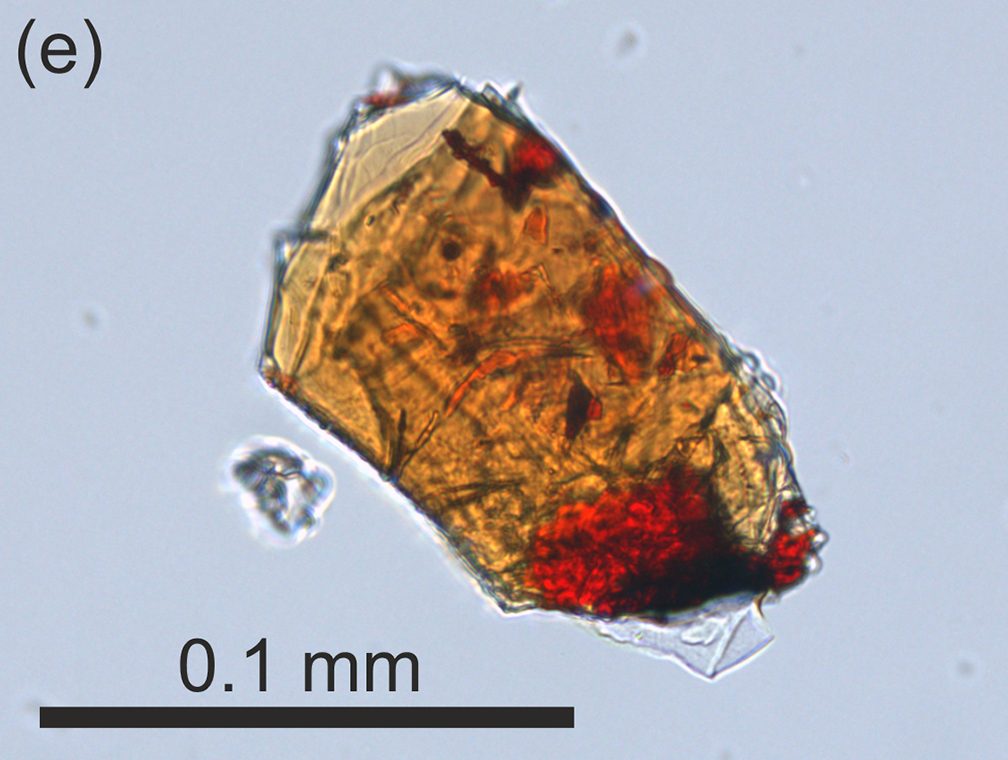
(a) Hematite segregation in wollastonite–gehlenite hornfels with grey-green esseneite crystals around it; (b) hematite enclave with a significant amount of hibonite, spinel, corundum, and dorrite; (c) hibonite overgrows and replaces kahlenbergite; (d) rare, relatively large kahlenbergite crystals in hematite; (e) kahlenbergite crystal flattened on (001) with epitaxial inclusions of hibonite (orange) and spinel inclusion (red); optical photo in immersion with n=1.63; (f) fragment of flattened kahlenbergite crystal with hexagonal elements of microrelief. Mineral symbols are hibonite (Hib), spinel (Sp), corundum (Crn), calcite (Cal), kahlenbergite (Khl), hematite (Hem), and pseudobrookite (Pbr). — Photo: Krüger, B., Galuskin, E. V., Galuskina, I. O., Krüger, H., and Vapnik, Y. · CC BY 4.0
Kahlenbergite
Kahlenbergite is an IMA-recognized mineral species in the oxides & hydroxide class, with the chemical formula KAl₁₁O₁₇.
It crystallizes in the hexagonal crystal system (space group P6_3/mmc). It is a member of the Magnetoplumbite structural group.
Key properties: Mohs hardness 6–7; specific gravity 3.4; Light brown streak; Vitreous luster; optically uniaxial.
IMA symbol Klb, IMA status: approved, named in 2019.
Formed at temperatures not less than 1000 flC under strongly oxidizing conditions in hematite segregations enriched by hibonite in wollastonite-gehlenite pyrometamorphic hornfels.
It is found associated with Hematite, hibonite, spinel, corundum, pseudobrookite.
The mineral was named to honor Volker Kahlenberg (b. 1964), Professor of applied mineralogy and crystallography at the University of Innsbruck, Austria.