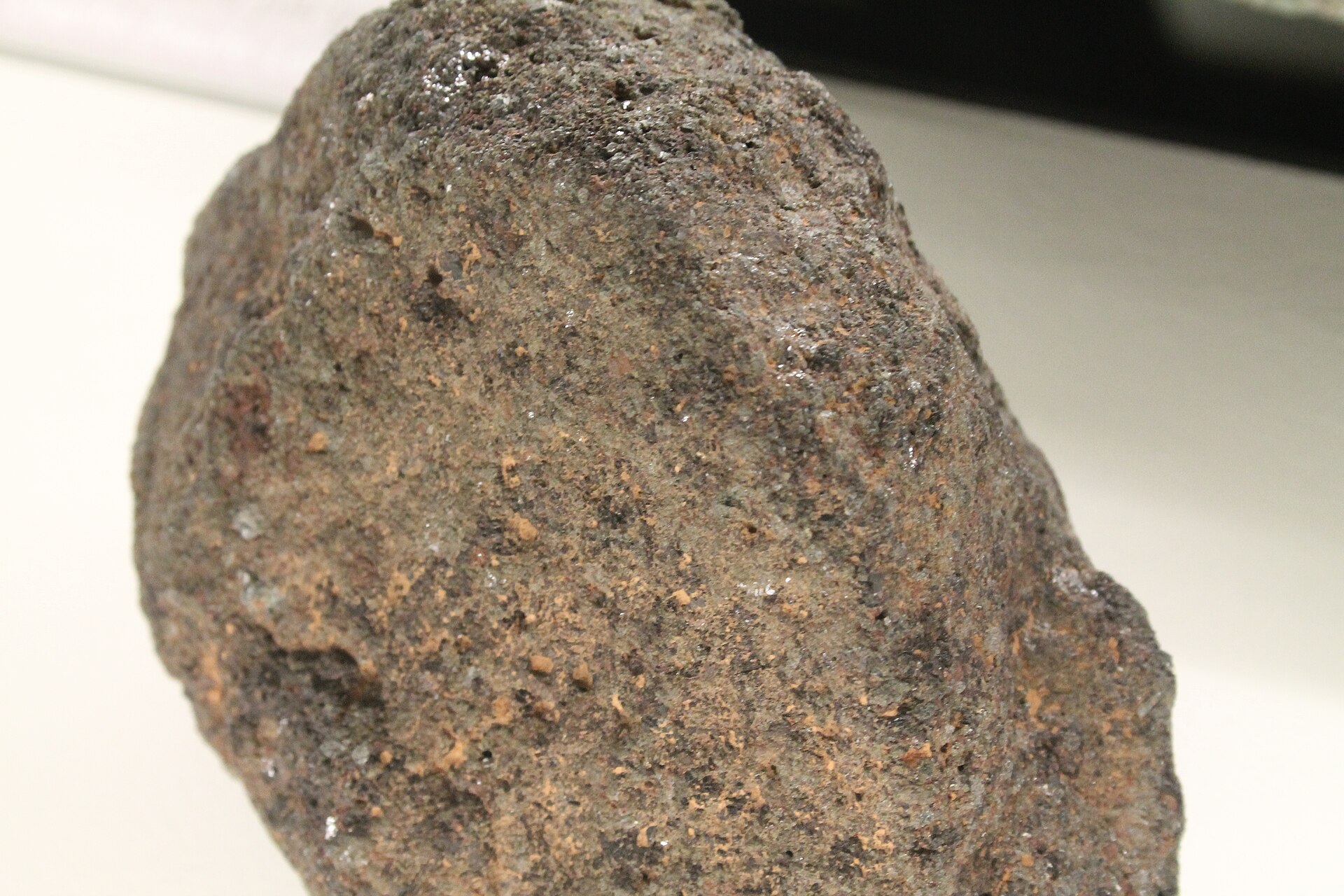
Amphibole kaersutite, en provenance de Alleyras (Haute-Loire, France), au Muséum de Nantes — Photo: Koreller · CC BY-SA 4.0
Kaersutite
A dark-brown to black titanium-bearing calcic amphibole — an oxy-amphibole of alkaline igneous rocks.
Intro adapted from Wikipedia (CC BY-SA).
Kaersutite is an IMA-recognized mineral species in the silicate class, with the chemical formula NaCa₂(Mg₃AlTi⁴⁺)(Si₆Al₂)O₂₂O₂.
It crystallizes in the monoclinic crystal system (space group C2/m). It is a member of the Amphibole structural group.
Key properties: Mohs hardness 5–6; specific gravity 3.2–3.28; typically brown or black; white streak; Vitreous luster; refractive index 1.711; optically biaxial.
IMA symbol Krs, IMA status: approved, named in 1893.
Common as phenocrysts in alkalic volcanic rocks; in gabbroic and peridotitic nodules in alkalic basalts; in syenites, monzonites, carbonatite tuffs, and alkalic gabbros.
It is found associated with Titanian augite, rhÄonite, olivine, ilmenite, spinel, plagioclase, titanian pargasite.
The name refers to the occurrence near Qaersut (formerly Kaersut), Greenland.
Collections: Collector Favorites.