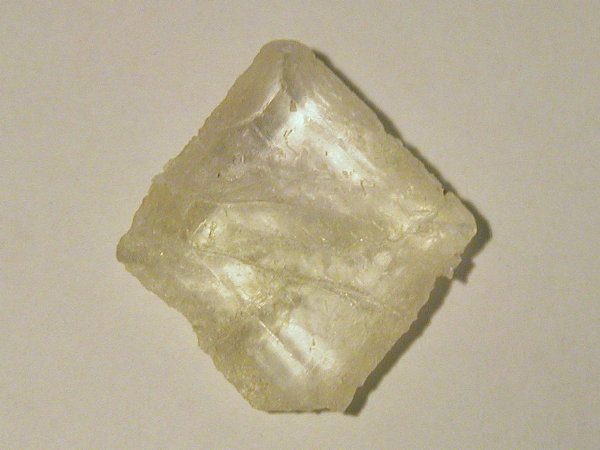
Idiomorphic Kainite - Locality: Brefeld Mine, Tarthun/Staßfurt, Saxony-Anhalt, Germany - crystal size: 3.8 cm — Photo: Thomas Witzke · CC BY-SA 3.0 de
Kainite
A hydrated potassium-magnesium sulfate-chloride evaporite mineral — historically mined for potash fertilizer.
Intro adapted from Wikipedia (CC BY-SA).
Kainite is an IMA-recognized mineral species in the sulfate class, with the chemical formula KMg(SO₄)Cl·2.75H₂O.
It crystallizes in the monoclinic crystal system (space group C2/m).
Key properties: Mohs hardness 2.5–3; specific gravity 2.15; Vitreous luster; refractive index 1.505; optically biaxial.
IMA symbol Kai, grandfathered status — known before the IMA’s founding, named in 1865.
Found as a secondary mineral in marine potash deposits, formed due to metamorphism or resolution by ground waters; rarely a volcanic sublimate.
It is found associated with Sylvite, halite, carnallite, kieserite, polyhalite, langbeinite, picromerite.
Its name comes from the Greek for recent, alluding to its recent origin.