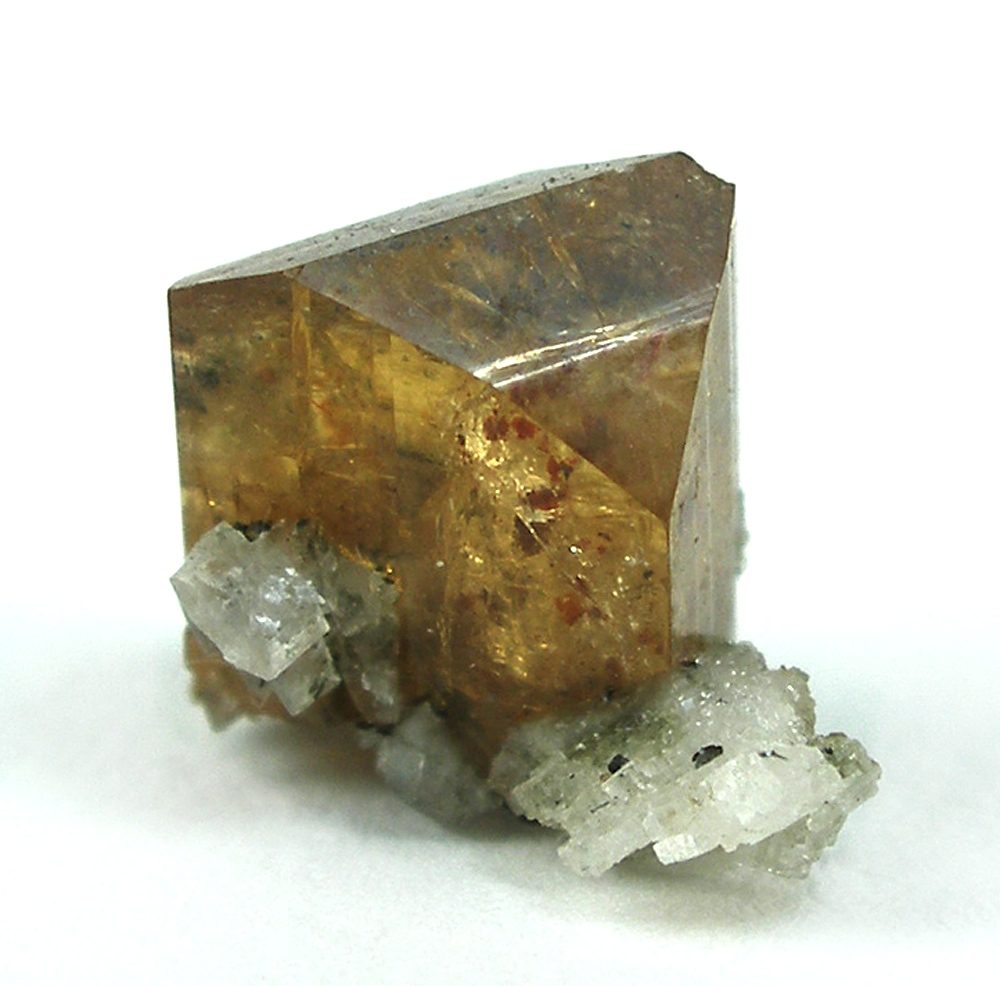
Kainosite-(Y) Locality: Amphibolite quarry, Urenkopf Mt., Haslach , Black Forest , Baden-Württemberg , Germany ( Locality at mindat.org ) Size: thumbnail, 0.8 x 0.6 x 0.4 cm Kainosite-(Y) A FACET-QUALITY, transparent, gem Kainosite crystal of a relatively large size for this species, from a classic locale. This crystal is gemmier in person, and really bright in lustre. It is from an old German collection being quietly dispersed. Although small, it is a superb example of the species in unusually fine quality. — Photo: Robert M. Lavinsky · CC BY-SA 3.0
Kainosite-(Y)
Kainosite is a silicate mineral that has the formula of Ca2(Y,Ce) SiO4O12(CO3)•(H2O). Kainosite was first discovered in Norway on the island of Hitterø and was named by Adolf Erik Nordenskiöld (1832–1901) in allusion to the Greek word for "unusual" for its rarity and exotic composition. Kainosite, is part of the orthorhombic crystal class minerals, which is a system that results from stretching a cubic lattice along two of its orthogonal pairs. Kainosite is a biaxial mineral, so the light entering its crystals will be polarized in two vibration directions (XYZ) for it has two optic axes.
Intro adapted from Wikipedia (CC BY-SA).
Kainosite-(Y) is an IMA-recognized mineral species in the silicate class, with the chemical formula Ca₂Y₂(SiO₃)₄(CO₃)·H₂O.
It crystallizes in the orthorhombic crystal system (space group Pmnb).
Key properties: Mohs hardness 5–6; specific gravity 3.52; Vitreous to resinous luster; refractive index 1.68; optically biaxial.
IMA symbol Kno-Y, IMA status: approved, named in 1886.
Found in vugs in pegmatites in granites and alkalic complexes.
It is found associated with Chamosite, pyrite, quartz, calcite, sphalerite, fluorite, uraninite, zircon, molybdenite (Bancroft, Canada); diopside, magnetite, clinochlore.
Its name comes from the Greek for unusual, for its rarity and exotic composition.