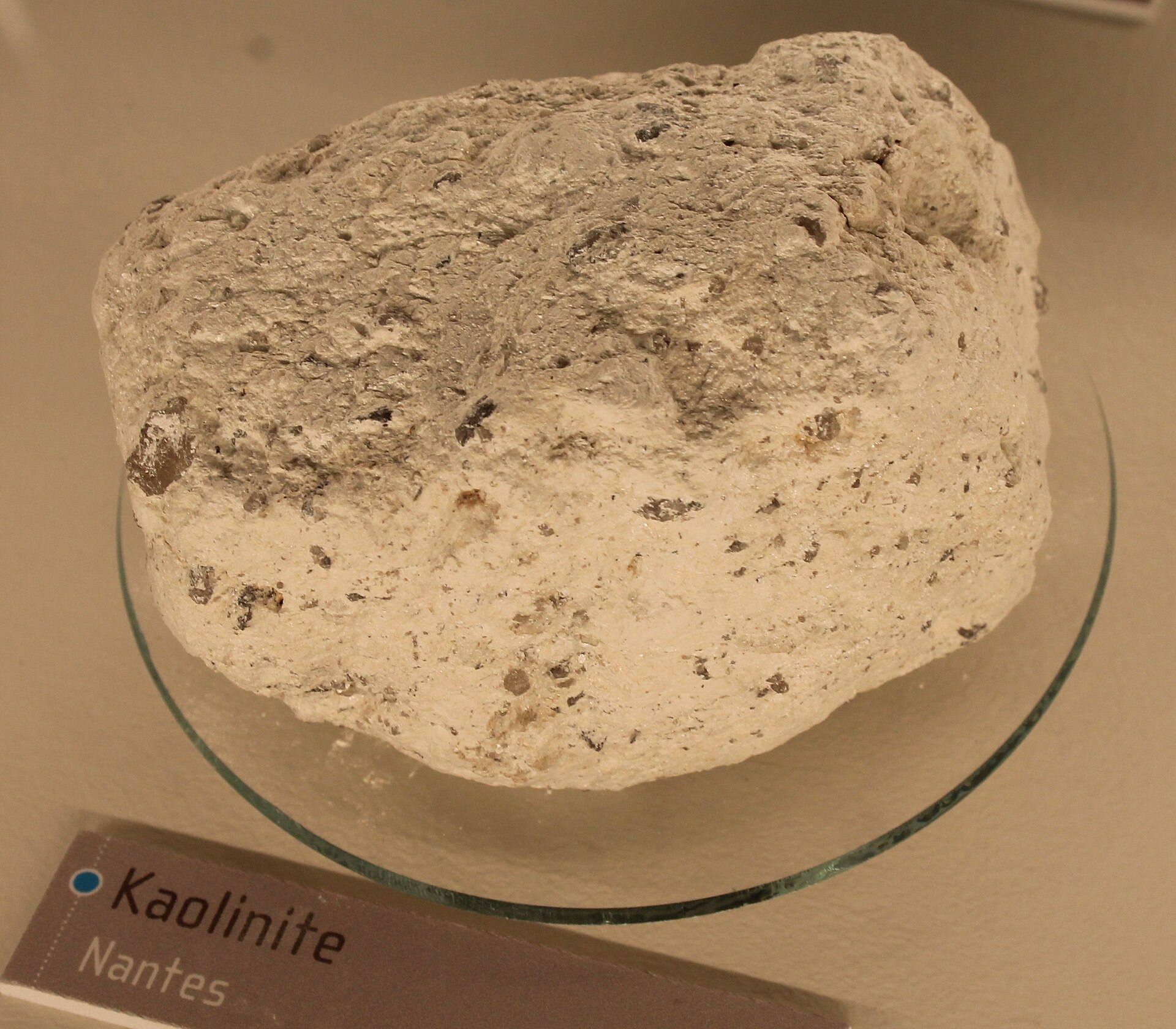
Kaolinite, en provenance de Nantes (France), au Muséum de Nantes — Photo: Koreller · CC BY-SA 4.0
Kaolinite
Also known as: Kaolin, China clay.
The archetypal clay mineral — soft white 'kaolin' that makes china clay, paper coatings and porcelain.
Intro adapted from Wikipedia (CC BY-SA).
Kaolinite is an IMA-recognized mineral species in the silicate class, with the chemical formula Al₂Si₂O₅(OH)₄.
It crystallizes in the triclinic crystal system (space group Cc). It is a member of the Clay, Kaolinite structural group.
Key properties: Mohs hardness 2–2.5; specific gravity 2.61–2.68; typically white or colorless or gray or yellow or brown or blue; white streak; Pearly to dull earthy luster; refractive index 1.564; optically biaxial.
IMA symbol Kln, IMA status: approved, named in 1867.
Replaces other aluminosilicate minerals during hydrothermal alteration and weathering. A common constituent of the clay-size fraction of sediments, where it may be formed by direct precipitation.
It is found associated with Quartz, feldspar, muscovite.
The name comes from a corruption of the Chinese Kauling, high ridge, for a Chinese occurrence. All rights reserved. No part of this publication may be reproduced.
Collections: Everyday Minerals.