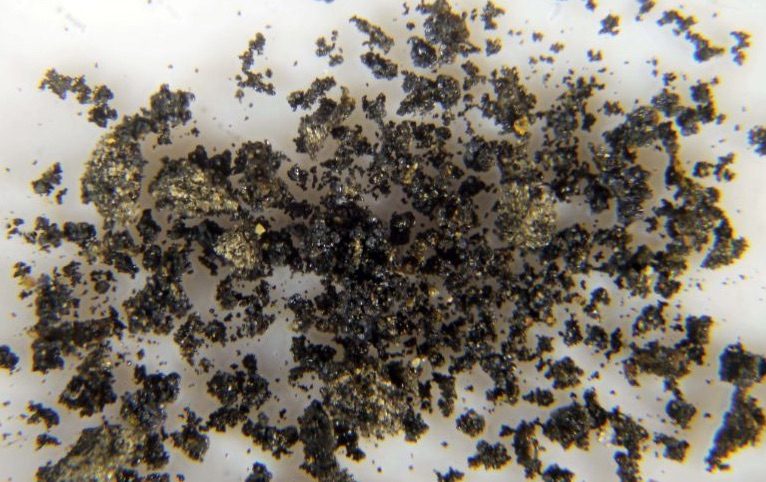
A lot of black microspecimens of karelianite from Finland (Outokumpu, North Karelia, Finland). Karelianite is a simple vanadium oxide. Ex Vandenbroucke Museum collection from Waregem, Belgium. — Photo: David Hospital · CC BY-SA 4.0
Karelianite
Natural vanadium(III) oxide — the vanadium analogue of hematite and eskolaite.
Intro adapted from Wikipedia (CC BY-SA).
Karelianite is an IMA-recognized mineral species in the vanadate class, with the chemical formula V₂O₃.
It crystallizes in the hexagonal crystal system (space group R-3c). It is a member of the Corundum structural group.
Key properties: Mohs hardness 8–9; specific gravity 4.95; Black streak.
IMA symbol Kar, IMA status: approved, named in 1963.
Found in sulfide-rich portions of glacial boulders derived from high-grade metamorphic rocks, as schists and quartzites (Outokumpu mine, Finland); in primary unoxidized U–V ores (Mounana mine, Gabon).
It is found associated with Pyrrhotite, chalcopyrite, pyrite, tremolite, graphite, titanite, quartz (Outokumpu mine, Finland); corvusite, montroseite, uraninite, quartz (Mounana mine.
The name refers to the Karelian schist belt, the region of Finland where the mineral occurs.