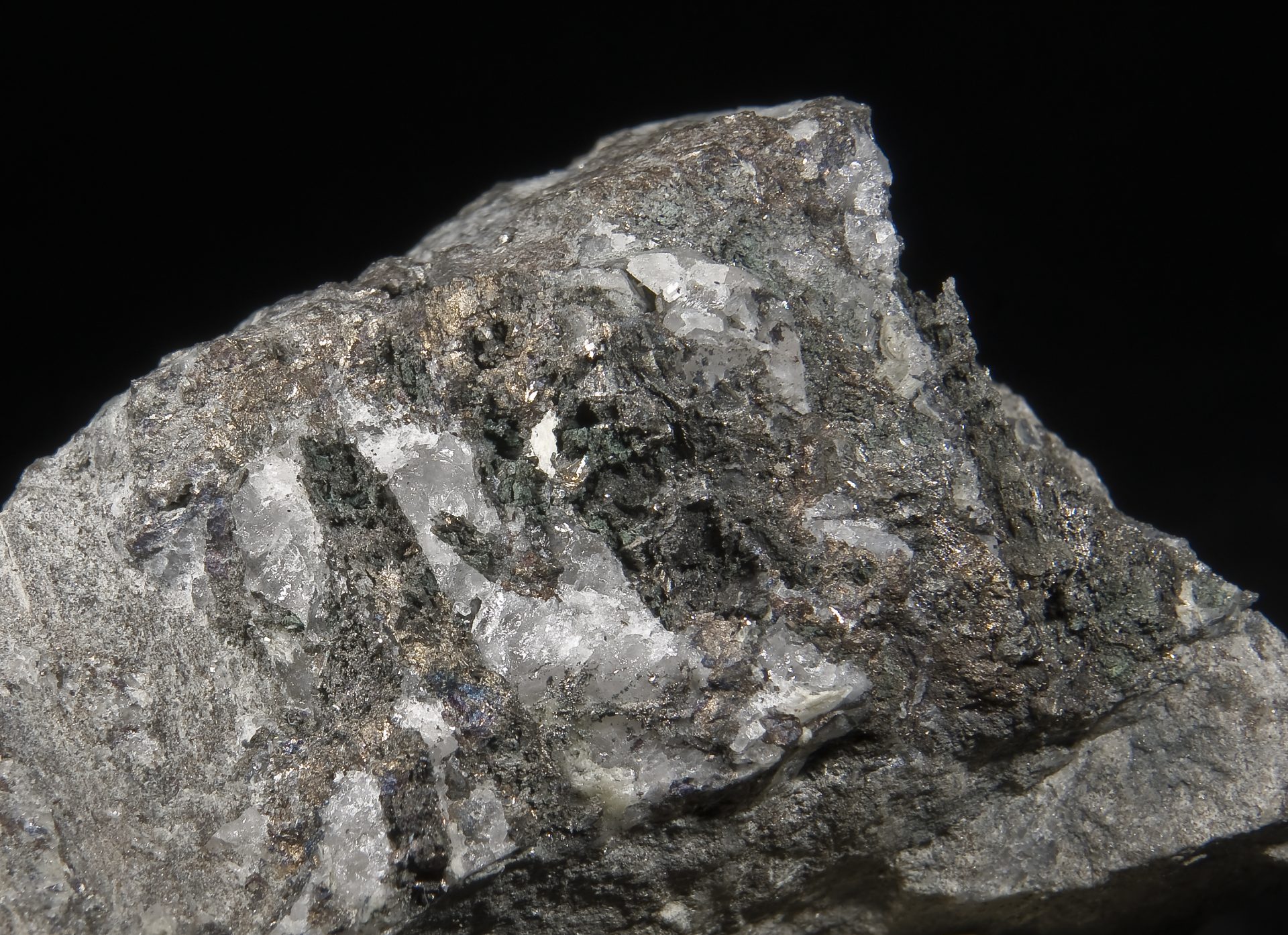
Kësterite - Cligga Mine, Cligga Head, Perranzabuloe, St Agnes District, Cornwall , England , UK — Photo: Didier Descouens · CC BY 4.0
Kësterite
A copper-zinc-tin sulfide in which zinc and iron share lattice sites — the zinc-rich partner of stannite.
Intro adapted from Wikipedia (CC BY-SA).
Kësterite is an IMA-recognized mineral species in the sulfide class, with the chemical formula Cu₂ZnSnS₄.
It crystallizes in the tetragonal crystal system (space group I-4). It is a member of the Sphalerite, Stannite structural group.
Key properties: Mohs hardness 4.5; specific gravity 4.54–4.59; Black streak; Metallic. R1 –R2: (400) 23.7–24.5, (420) 24.4–25.2, (440) 24.9–25.8, (460) 25.4–26.0, (480) 25.6–26.0, (500) 25.6–25.9 luster.
IMA symbol Kës, grandfathered status — known before the IMA’s founding, named in 1956.
Found in quartz-sulfide hydrothermal veinlets in tin deposits.
It is found associated with Arsenopyrite, stannoidite, chalcopyrite, chalcocite, sphalerite, tennantite.
The name is derived from the locality in Russia at the Kester deposit.