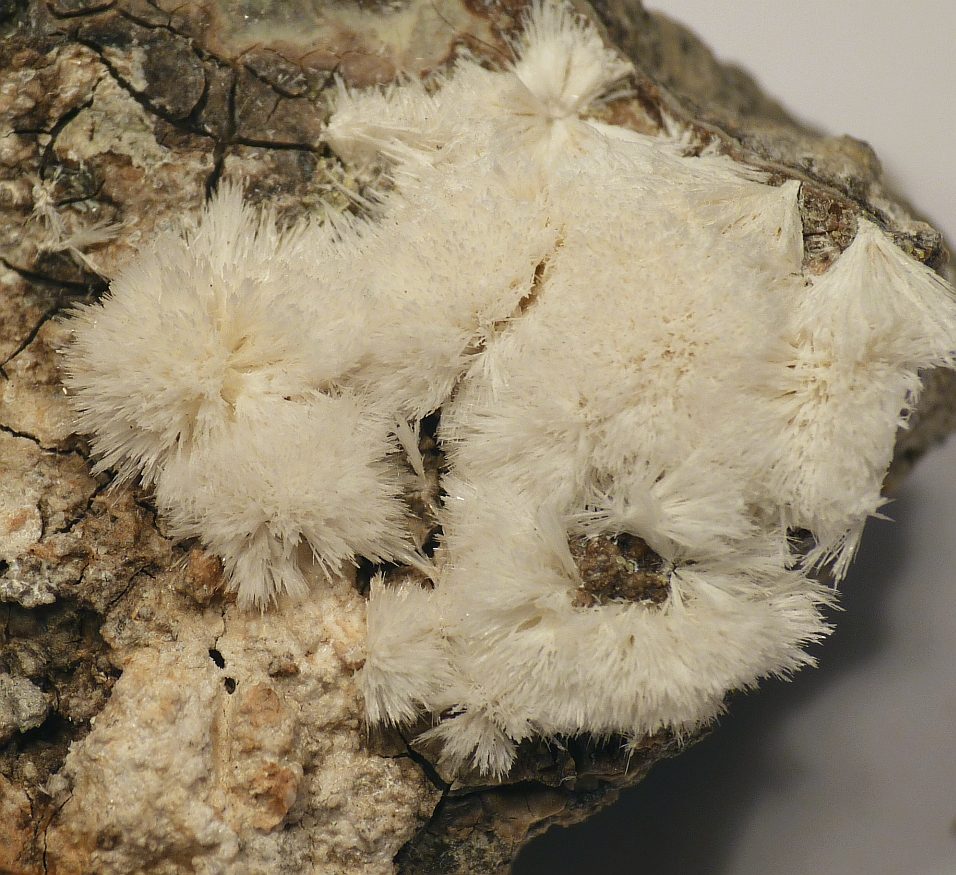
Köttigite Locality: Silbereckle Mine, Reichenbach, Lahr, Black Forest, Baden-Württemberg, Germany Field of view 8 mm — Photo: Leon Hupperichs · CC BY-SA 3.0
Köttigite
A rare hydrated zinc arsenate named in 1850 for Otto Köttig, the Schneeberg chemist who analyzed it.
Intro adapted from Wikipedia (CC BY-SA).
Köttigite is an IMA-recognized mineral species in the arsenate class, with the chemical formula Zn₃(AsO₄)₂·8H₂O.
It crystallizes in the monoclinic crystal system (space group C2/m). It is a member of the Vivianite structural group.
Key properties: Mohs hardness 2–3; specific gravity 3.33; White to reddish white streak; Silky on cleavages luster; refractive index 1.644; optically biaxial.
IMA symbol Köt, grandfathered status — known before the IMA’s founding, named in 1850.
A rare secondary mineral found in the oxidation zone of some zinc deposits.
It is found associated with Symplesite, parasymplesite, adamite, legrandite, metaköttigite, gypsum (Ojuela mine, Mexico); pharmacosiderite, legrandite, scorodite, adamite (Sterling Hill.
The mineral was named to honor Otto Köttig (1824–1892), chemist, of Schneeberg, Germany, who published the first description of the mineral.