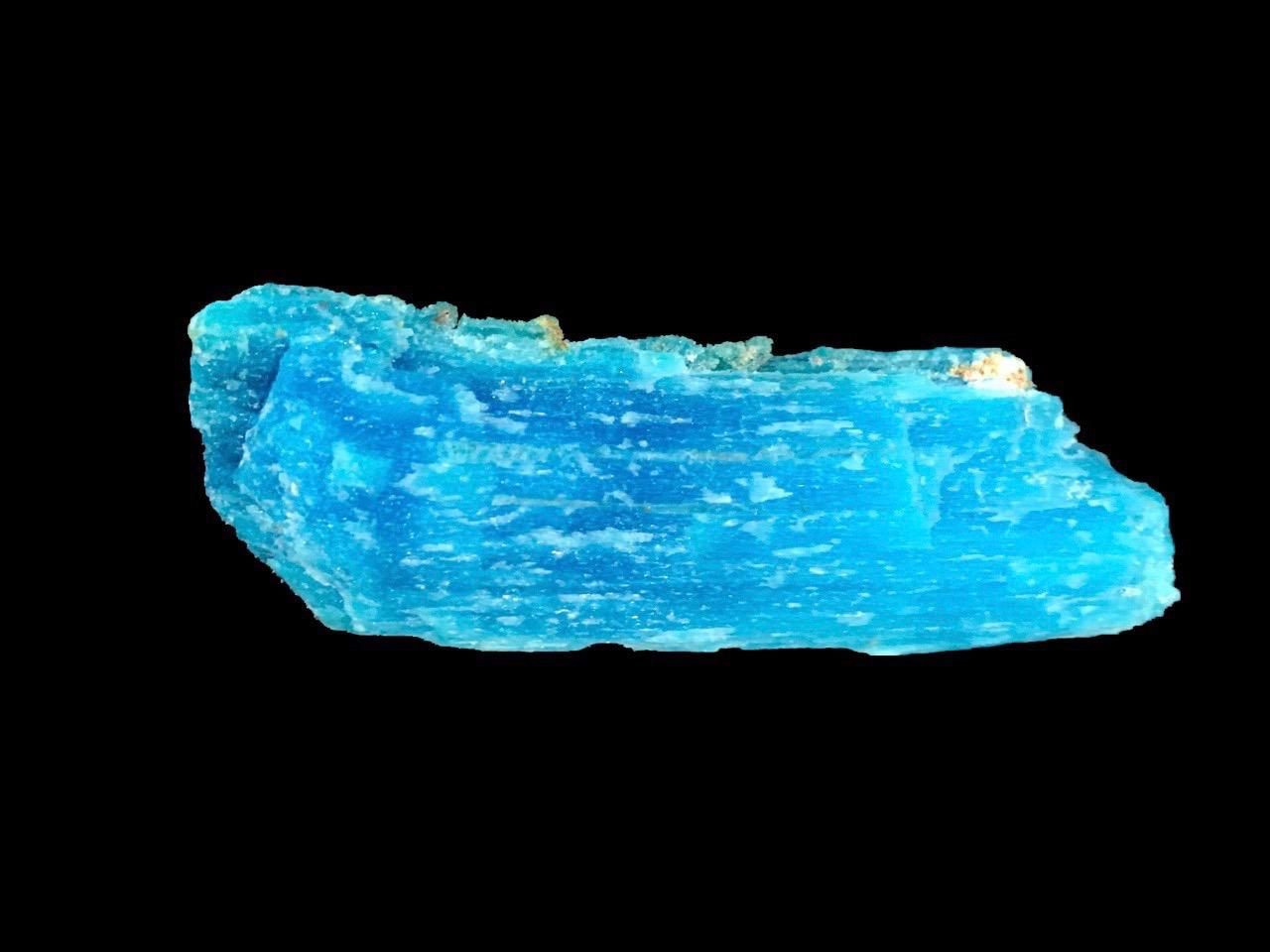
A unique, singular crystal of light blue Kröhnkite from a type locality. It stands out from other minerals of the species due to its condition and state of no damage. Type locality of kröhnkite is Chuquicamata Mine, Chuquicamata District, Calama, El Loa Province, Antofagasta, Chile ( locality at mindat.org ) — Photo: Prospectorminerals · CC BY-SA 4.0
Kröhnkite
A rare azure hydrated sodium-copper sulfate named for B. Kröhnke; heating above 200 °C turns it into saranchinaite.
Intro adapted from Wikipedia (CC BY-SA).
Kröhnkite is an IMA-recognized mineral species in the sulfate class, with the chemical formula Na₂Cu(SO₄)₂·2H₂O.
It crystallizes in the monoclinic crystal system (space group P2_1/c). It is a member of the Roselite structural group.
Key properties: Mohs hardness 2.5–3; specific gravity 2.9; Vitreous luster; refractive index 1.574; optically biaxial.
IMA symbol Khk, grandfathered status — known before the IMA’s founding, named in 1879.
An uncommon secondary mineral formed in the oxidized zone of copper deposits, typically in very arid climates.
It is found associated with Atacamite, blödite, chalcanthite, antlerite, natrochalcite (Chuquicamata, Chile).
The mineral was named to honor B. Kröhnke, who provided the first analysis of the mineral.