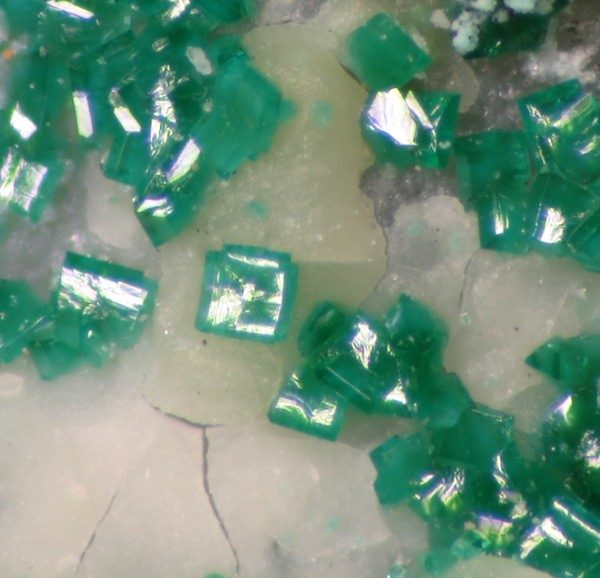
Ktenasite Locality: Maria Josefa Mine, Rodalquilar, Níjar, Almería, Andalusia, Spain Picture width 1 mm. Collection and photograph Christian Rewitzer. (Microprobed specimen) — Photo: Christian Rewitzer · CC BY-SA 3.0
Ktenasite
Ktenasite is an IMA-recognized mineral species in the sulfate class, with the chemical formula ZnCu₄(SO₄)₂(OH)₆·6H₂O.
It crystallizes in the monoclinic crystal system (space group P2_1/c). It is a member of the Ktenasite, Devilline structural group.
Key properties: Mohs hardness 2–2.5; specific gravity 2.94–2.97; Vitreous luster; optically biaxial.
IMA symbol Kte, grandfathered status — known before the IMA’s founding, named in 1950.
An uncommon secondary mineral produced through oxidation of chalcopyrite and sphalerite in Cu–Zn hydrothermal mineral deposits and in mine dumps.
It is found associated with Glaucocerinite, serpierite, smithsonite, gypsum, namuwite, schulenbergite.
The mineral was named to honor Professor Konstantin Anton Ktenas (1884–1935), Greek mineralogist.