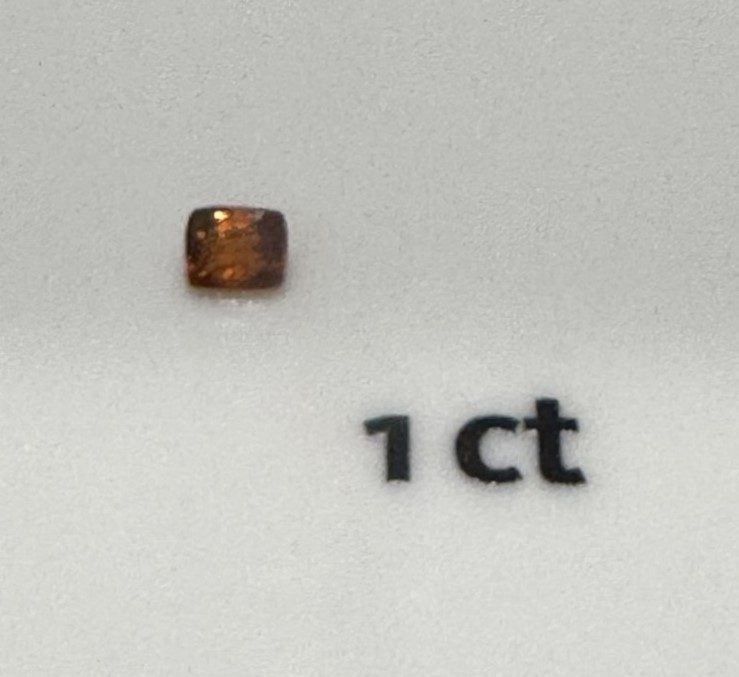
Photo of the only naturally occuring sample of Kyawthuite , which is on display at the Natural History Museum of Los Angeles. — Photo: Hotdogsyrup · CC0
Kyawthuite
Bismuth antimonate — perhaps the world's rarest mineral, known from a single crystal held by the Natural History Museum of Los Angeles.
Intro adapted from Wikipedia (CC BY-SA).
Kyawthuite is an IMA-recognized mineral species in the oxides & hydroxide class, with the chemical formula Bi³⁺Sb⁵⁺O₄.
It crystallizes in the monoclinic crystal system (space group I2/c). It is a member of the Clinocervantite structural group.
Key properties: Mohs hardness 5; specific gravity 8.256; White streak; Adamantine luster; optically biaxial.
IMA symbol Kyw, IMA status: approved, named in 2015.
Only known from alluvium, the presence of Bi, Sb and small amounts of Ta, as well as trace amounts of Ti, Nb, W and U, suggest an origin in a pegmatite.
The mineral was named to honor Dr. Kyaw Thu (b. 1973), a Burmese mineralogist-petrologist-gemologist on the staff of the Geology Department of Yangon University from 1998 to 2005.