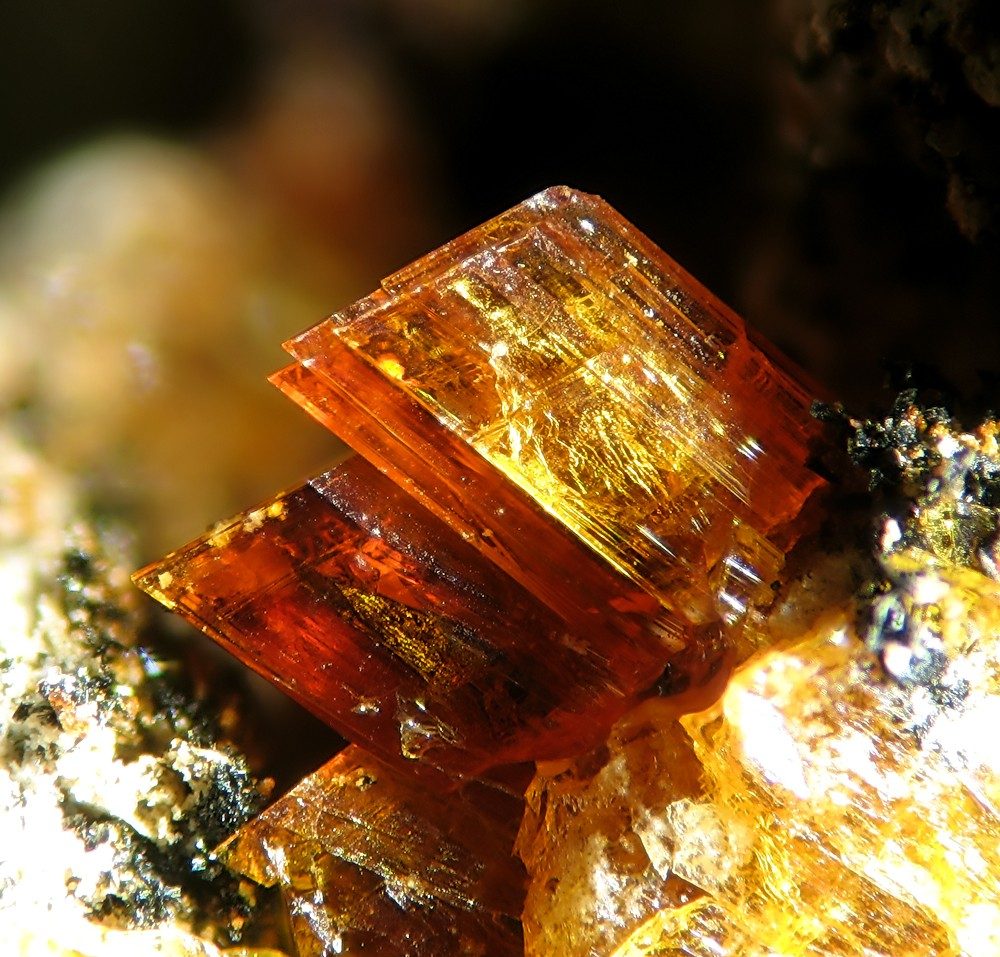
Laueite Locality: Hagendorf South Pegmatite (Cornelia Mine; Hagendorf South Open Cut), Hagendorf , Waidhaus , Vohenstrauß , Oberpfälzer Wald , Upper Palatinate , Bavaria , Germany ( Locality at mindat.org ) Picture width 2,5 mm. Collection and photograph Christian Rewitzer — Photo: Christian Rewitzer · CC BY-SA 3.0
Laueite
Laueite is an IMA-recognized mineral species in the phosphate class, with the chemical formula Mn²⁺Fe³⁺₂(PO₄)₂(OH)₂·8H₂O.
It crystallizes in the triclinic crystal system (space group P-1). It is a member of the Laueite structural group.
Key properties: Mohs hardness 3; specific gravity 2.44–2.49; Vitreous luster; optically biaxial.
IMA symbol Lae, grandfathered status — known before the IMA’s founding, named in 1954.
A common late-stage hydrothermal mineral in oxidized triphylite-bearing complex granite pegmatites.
It is found associated with Rockbridgeite (Hagendorf, Germany); rockbridgeite, strunzite, stewartite, pseudolaueite, siderite, ludlamite (Palermo #1 mine, New Hampshire, USA).
The mineral was named to honor Max Theodor Felix von Laue (1879–1960), German physicist, University of Munich, Munich, Germany, awarded the Nobel prize for his discovery of X-ray diffraction.