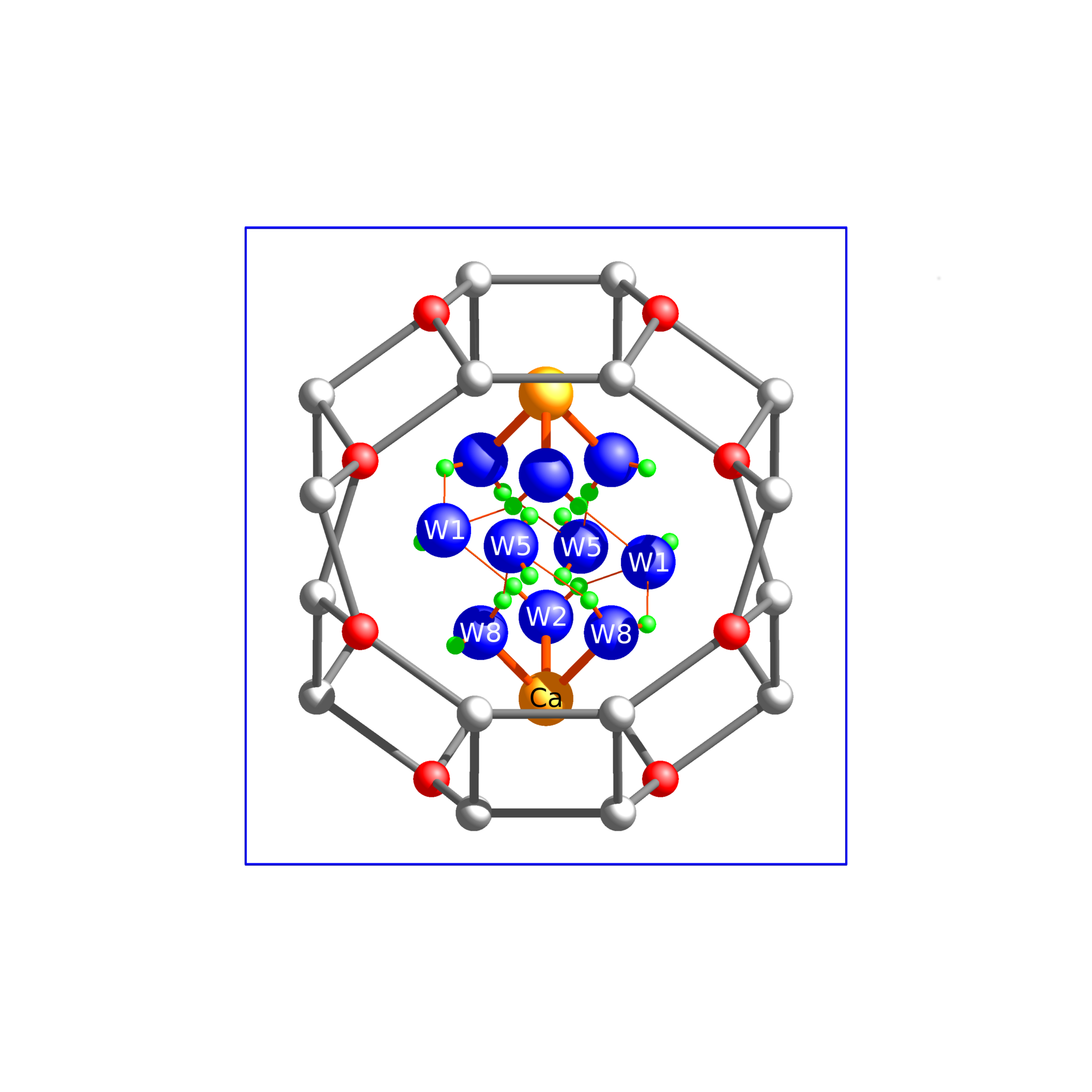
Laumontite structure viewed down the c-axis into the cavern of the alumosilicate framework Data from Kenny Stahl, Gilberto Artioli, 1993: A neutron powder diff — Photo: Bubenik · CC BY-SA 4.0
Laumontite
A common zeolite — hydrated calcium aluminosilicate forming white prisms in basalt cavities and low-grade metamorphic rocks.
Intro adapted from Wikipedia (CC BY-SA).
Laumontite is an IMA-recognized mineral species in the silicate class, with the chemical formula CaAl₂Si₄O₁₂·4H₂O.
It crystallizes in the monoclinic crystal system (space group C2/m).
Key properties: Mohs hardness 3.5–4; specific gravity 2.23–2.41; typically white or pink or yellow or brown; White streak; Vitreous to pearly on cleavages luster; optically biaxial.
IMA symbol Lmt, IMA status: approved, named in 1805.
Of hydrothermal origin, lining cavities in igneous rocks. Thick sedimentary beds rich in laumontite can form by decomposition of analcime or metamorphism of plagioclase. May be authigenic, cementing sandstones.
It is found associated with Zeolites, apophyllite, datolite, calcite, chlorite.
The name refers to Fran»cois Pierre Nicolas Gillet de Laumont (1747–1834), who first found the mineral.
Collections: Collector Favorites.