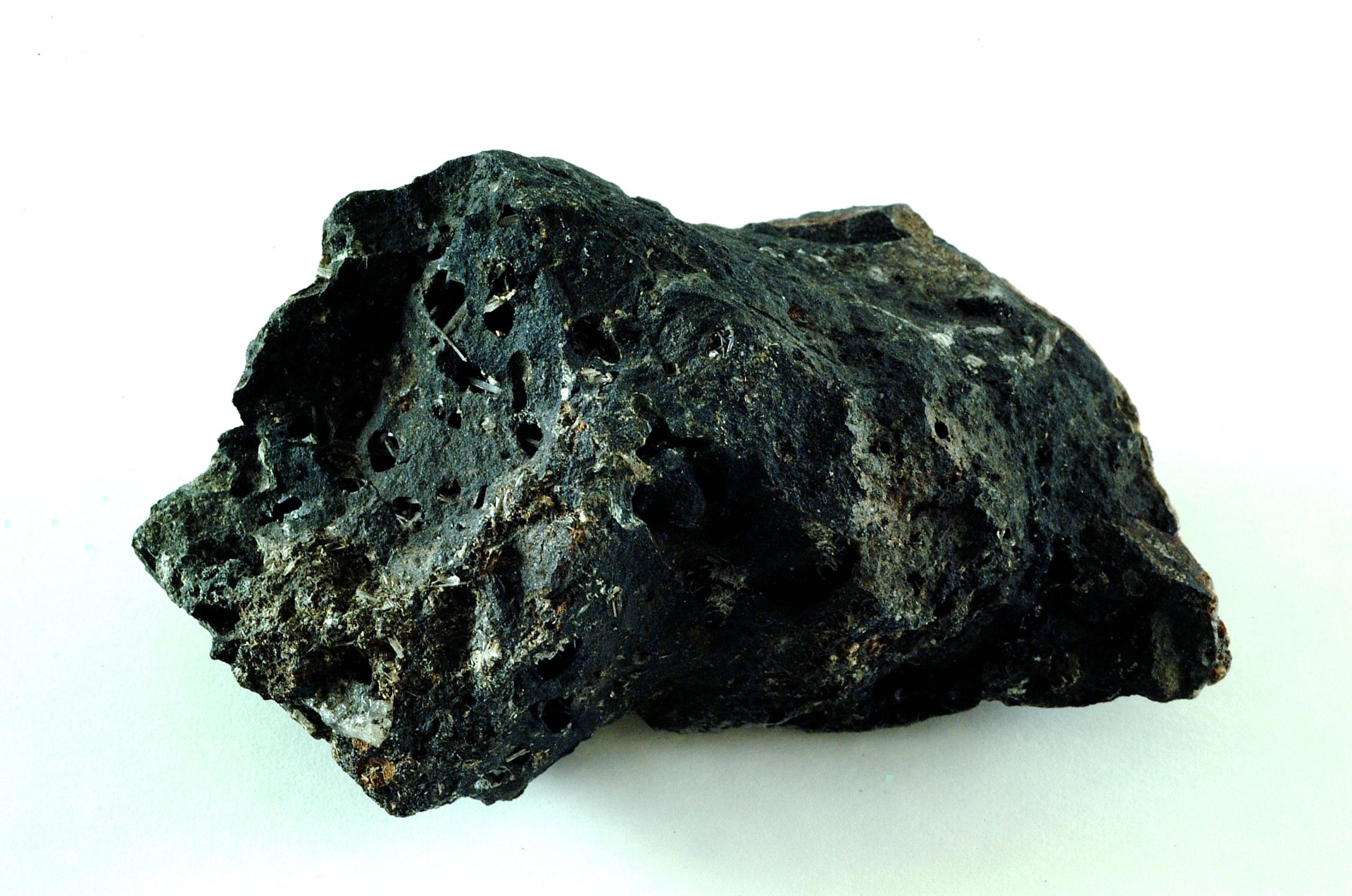
This is a specimen of lead slag from Larium, Greece. The slag is debris from ore processing associated with mining operations. The vugs and holes in this sample contain small white crystals (needles and prisms) of laurionite, PbCl(OH). Laurionite is a rare chloride mineral, only found in lead slags, and only at a few localities in the world. This sample is about 7.5 cm across. — Photo: Shannon Heinle · CC0
Laurionite
A lead hydroxychloride forming colorless orthorhombic crystals, dimorphous with paralaurionite, from the ancient slags of Laurion.
Intro adapted from Wikipedia (CC BY-SA).
Laurionite is an IMA-recognized mineral species in the halide class, with the chemical formula PbCl(OH).
It crystallizes in the orthorhombic crystal system (space group Pcmn).
Key properties: Mohs hardness 3–3.5; specific gravity 6.241; Adamantine, pearly on {100} luster; refractive index 2.117; optically biaxial.
IMA symbol Lri, grandfathered status — known before the IMA’s founding, named in 1887.
Produced by the action of saline water on lead-bearing slag. In the oxidized zone of lead-bearing mineral deposits.
It is found associated with Paralaurionite, penfieldite, fiedlerite, phosgenite, cerussite, anglesite.
The name refers to the occurrence at Laurium, Greece.