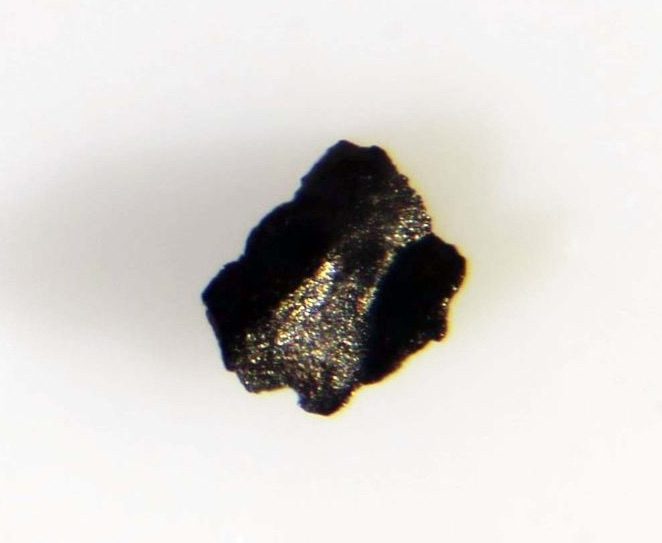
Very small single nugget of the extremely rare ruthenium sulphide mineral laurite (RuS2) from a river in Alaska (United States of America). Specimen analyzed by SEM/EDS by the former owner of the specimen (The Vandenbroucke Museum). Ex Vandenbroucke Museum collection from Waregem, Belgium. — Photo: David Hospital · CC BY-SA 4.0
Laurite
Ruthenium sulfide — an opaque black metallic mineral of the pyrite group found in platinum placers.
Intro adapted from Wikipedia (CC BY-SA).
Laurite is an IMA-recognized mineral species in the sulfide class, with the chemical formula RuS₂.
It crystallizes in the cubic crystal system (space group Pa3). It is a member of the Pyrite structural group.
Key properties: Mohs hardness 7.5; specific gravity 6.43; Dark gray streak; Metallic. R: (400) 51.2, (420) 49.8, (440) 48.5, (460) 47.0, (480) 45.7, (500) 44.6, (520) 43.7, (540) 42.8 luster.
IMA symbol Lrt, grandfathered status — known before the IMA’s founding, named in 1866.
Found in ultramafic complexes and in placer deposits.
It is found associated with Cooperite, braggite, sperrylite, other minerals of the platinum-group elements, chromite.
The name refers to Laura R. Joy, wife of Charles A. Joy, American chemist, Columbia University, New York City, USA.