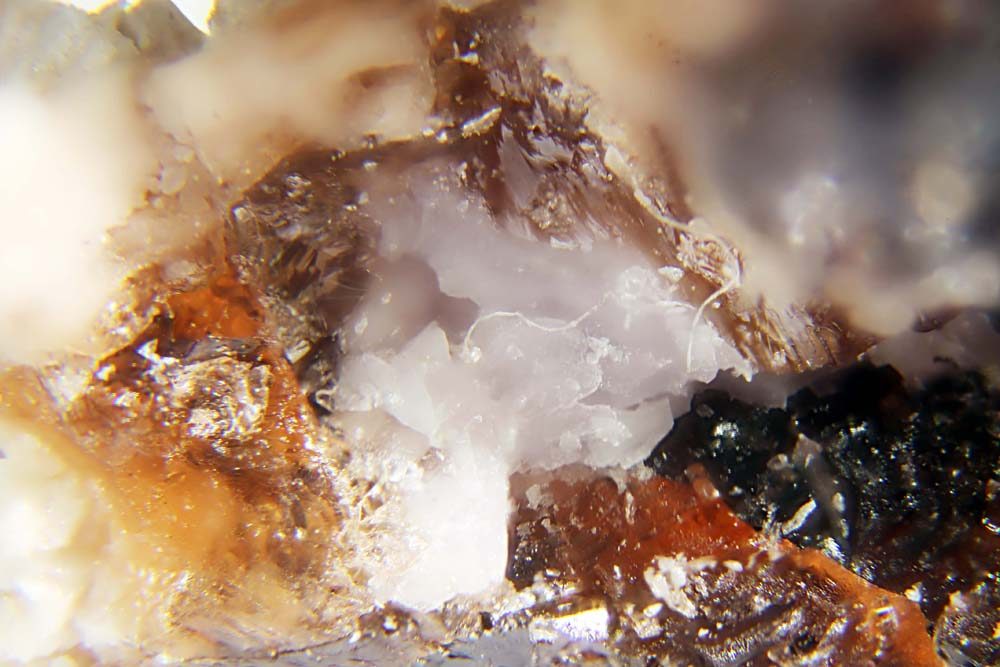
Colorless lausenite crystals associated to brown romerite. Analyzed specimen. From: Alcaparrosa Mine, Cerritos Bayos, El Loa Province, Antofagasta Region, Chile. — Photo: David Hospital · CC BY-SA 4.0
Lausenite
Lausenite is an IMA-recognized mineral species in the sulfate class, with the chemical formula Fe³⁺₂(SO₄)₃·5H₂O.
It crystallizes in the monoclinic crystal system (space group P2_1/m).
Key properties: Silky luster; optically biaxial.
IMA symbol Lse, grandfathered status — known before the IMA’s founding, named in 1928.
A very rare mineral, formed as the result of burning of a pyritic orebody (United Verde mine, Arizona, USA); on a burning waste heap produced through oxidation of pyrite reacting with clay (Velikomostov-2 mine, Ukraine).
It is found associated with Copiapite (United Verde mine, Arizona, USA); kieserite (Velikomostov-2 mine, Ukraine).
The mineral was named to honor Carl B. Lausen, geologist, United Verde Mining Co., Jerome, Arizona, USA, who discovered the mineral.