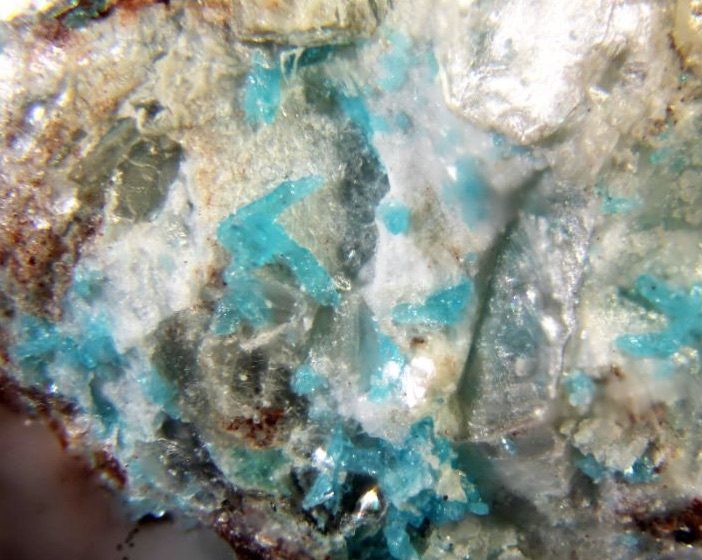
Outstanding sky blue crystals of the extremely rare organic mineral lazaraskeite from the type and only known locality worldwide in Arizona (Western End, Pusch Ridge, Pima County, Arizona, United States of America). As an organic compound, the formula may also be written as Cu(OCOCH2OH)2 or Cu[O(CO)CH2(OH)]2. Known as a synthetic compound ('bis(glycolato)copper(II)') - first natural crystalline glycolate mineral. — Photo: David Hospital · CC BY-SA 4.0
Lazaraskeite
Lazaraskeite is an IMA-recognized mineral species in the organic mineral class, with the chemical formula Cu(C₂H₃O₃)₂.
It crystallizes in the monoclinic crystal system. It is a member of the Glycolate structural group.
Key properties: Mohs hardness 2; specific gravity 2.12; White streak; Vitreous luster; optically biaxial.
IMA symbol Lza, IMA status: approved, named in 2019.
Formed by the interaction of fluids containing glycolic acid (C 2H4O3) with copper produced by the oxidation of primary and secondary minerals.
It is found associated with Chrysocolla, malachite, wulfenite, mimetite, hydroxylpyromorphite, hematite, microcline, muscovite, quartz.
The mineral was named to honor the finders of the studied material, Warren G. Lazar and Beverly Raskin, avid prospectors and hunters of meteorites and minerals.