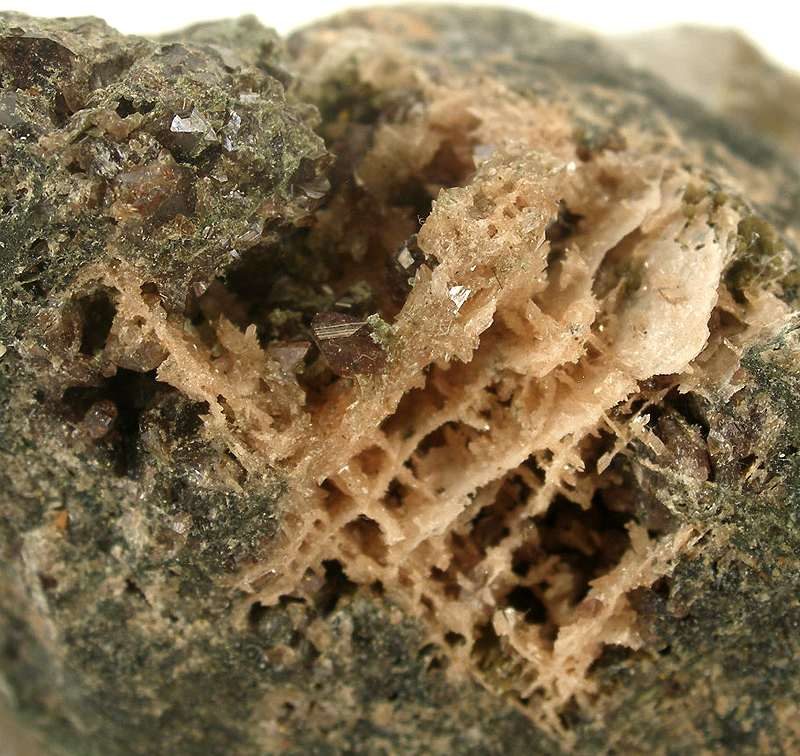
Hureaulite , Leucophosphite Locality: White Elephant Mine, Cicero Peak, Pringle , Custer District, Custer County, South Dakota , USA ( Locality at mindat.org ) Size: small cabinet, 9.8 x 5.4 x 3.4 cm Leucophosphite and Hureaulite Professor W.L. Roberts, the noted authority on phosphates of the amazingly rich and varied deposits in Custer County, sold this to John White at the Seattle Show in 1971. On the back of White's label, he notes that " Prof. Roberts says that this is one of the three best known specimens of Leucophosphite". The large, sharp brown crystals are robust and stereotypic for the species, and are not the typical micros. Whether that holds true still today, I am not sure. However, the image gallery on MINDAT shows that most examples are micros, or clusters of micros to 7mm. These sharp, euhedral, obvious and eye-visible crystals individually reach 3 mm or so. They sit perched in a very interesting matrix of finely reticulated hureaulite crystals which cross the protected cavity in this rock, in which the leucophosphite has grown. Ex. John White Collection. — Photo: Robert M. Lavinsky · CC BY-SA 3.0
Leucophosphite
A potassium-iron phosphate derived from bird and bat guano.
Intro adapted from Wikipedia (CC BY-SA).
Leucophosphite is an IMA-recognized mineral species in the phosphate class, with the chemical formula KFe³⁺₂(PO₄)₂(OH)·2H₂O.
It crystallizes in the monoclinic crystal system (space group P2_1/n). It is a member of the Leucophosphite structural group.
Key properties: specific gravity 2.948; Vitreous to waxy, chalky luster; optically biaxial.
IMA symbol Lpp, grandfathered status — known before the IMA’s founding, named in 1932.
Formed by reaction between bat or bird guano and earlier iron-bearing minerals; by hydrothermal alteration of iron-rich phosphates in complex granite pegmatites; crosscutting fluorapatite nodules in black shale; replacing fossil wood.
It is found associated with Variscite, “chalcedony”, “opal” (Ninghanboun Hills, Australia); strengite, phosphosiderite (Liberia); cyrilovite, phosphosiderite, manganoan lipscombite.
Its name comes from the Greek for white and the phosphate in its composition.