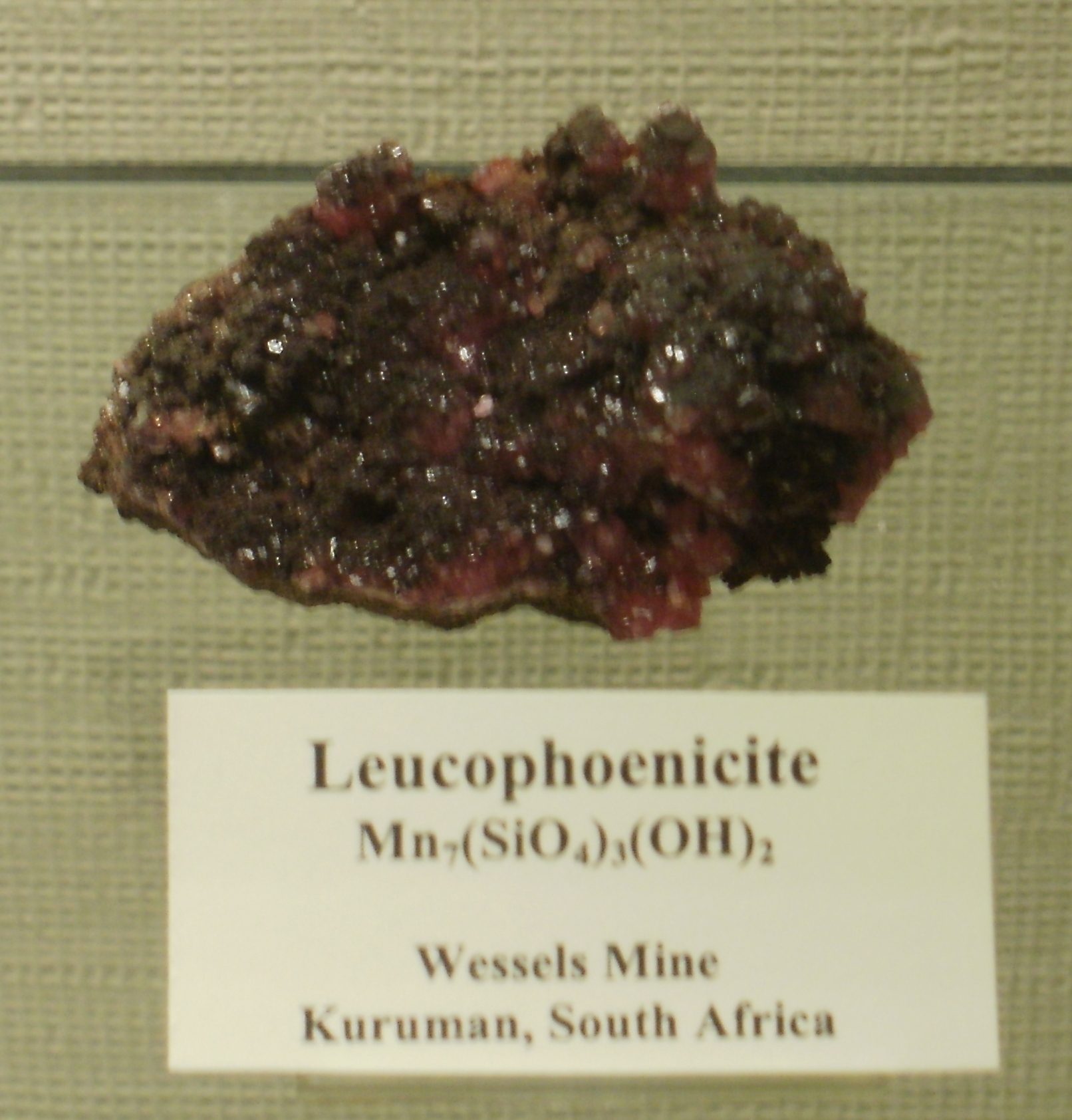
Leucophoenicite from the Wessels Mine in Kuruman , South Africa. Held in the A. E. Seaman Mineral Museum . — Photo: Chris857 · CC BY-SA 3.0
Leucophoenicite
A manganese silicate-hydroxide whose name means 'pale purple-red' — identified as a new species in New Jersey in 1899.
Intro adapted from Wikipedia (CC BY-SA).
Leucophoenicite is an IMA-recognized mineral species in the silicate class, with the chemical formula Mn²⁺₇(SiO₄)₃(OH)₂.
It crystallizes in the monoclinic crystal system (space group P2_1/a). It is a member of the Humite structural group.
Key properties: Mohs hardness 5.5–6; specific gravity 3.848; Vitreous luster; refractive index 1.768; optically biaxial.
IMA symbol Lpo, grandfathered status — known before the IMA’s founding, named in 1899.
A late-stage hydrothermal or contact zone mineral in veins and skarns in a metamorphosed stratiform Zn-Mn orebody (Franklin, New Jersey, USA).
It is found associated with Willemite, franklinite, calcite, vesuvianite, garnet, sussexite, rhodochrosite, pyrochroite, tephroite, sonolite, jerrygibbsite, glaucochroite, manganosite.
Its name comes from the Greek for pale and purplish red in reference to its conspicuous color.