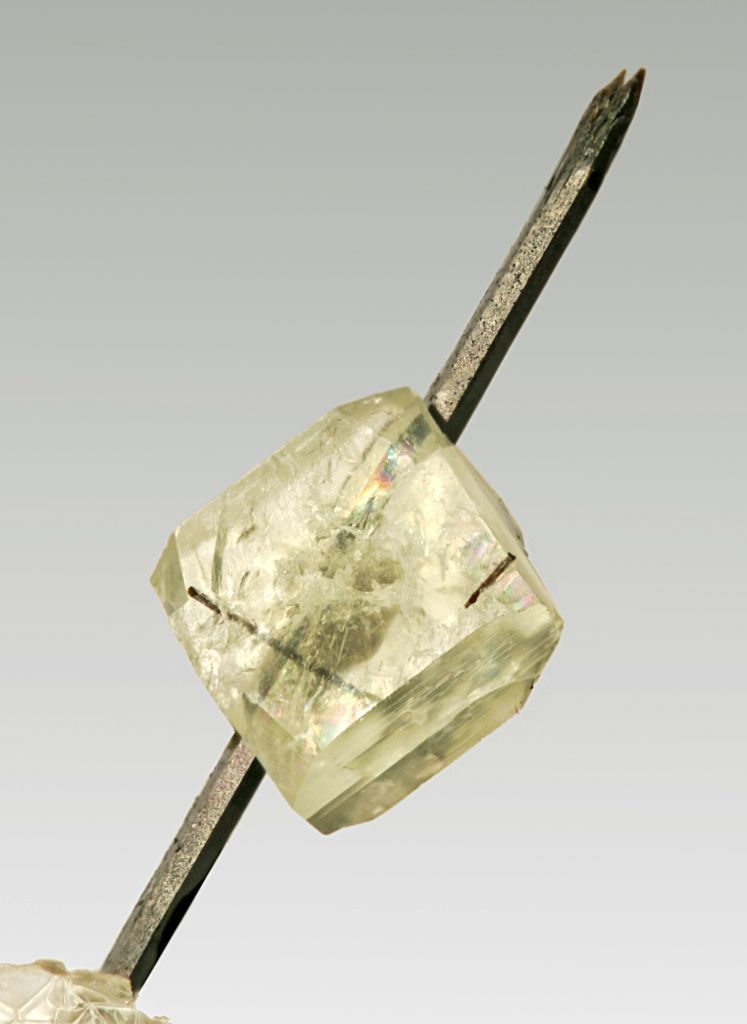
Leucophanite , Aegirine Locality: Poudrette quarry (Demix quarry; Uni-Mix quarry; Desourdy quarry; Carrière Mont Saint-Hilaire), Mont Saint-Hilaire, La Vallée-du-Richelieu RCM, Montérégie, Québec, Canada The leucophanite is about 4-5 mm on edge. Via Jean-Pierre Beckerich. MOB coll. This is from a well known find that produced considerably larger gemmy xls - see Min Rec 7-8/1990 p. 320 — Photo: Modris Baum · Public domain
Leucophanite
A rare beryllium-bearing inosilicate forming yellow triclinic crystals in alkaline igneous complexes.
Intro adapted from Wikipedia (CC BY-SA).
Leucophanite is an IMA-recognized mineral species in the silicate class, with the chemical formula NaCaBeSi₂O₆F.
It crystallizes in the orthorhombic crystal system (space group P1).
Key properties: Mohs hardness 3.5–4; specific gravity 2.96; White streak; Vitreous luster; optically biaxial.
IMA symbol Lph, grandfathered status — known before the IMA’s founding, named in 1840.
Found in pegmatites in augite syenite (Langesundsfjord, Norway); in albitization zones in pegmatites at the contact of alkalic massifs intruding Proterozoic carbonaceous quartz-sericite schists (Baikal massif, Russia).
It is found associated with Albite, orthoclase, natrolite, analcime, s¶erandite, aegirine, polylithionite, ancylite, astrophyllite, catapleiite, epididymite, rhodochrosite, fluorite.
Its name comes from the Greek for white and to appear, its common color.