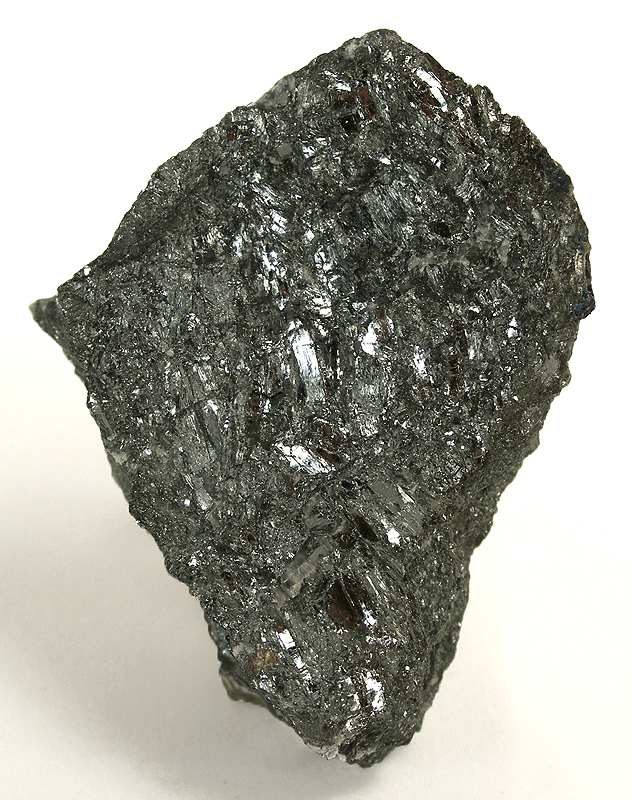
Livingstonite Locality: Huitzuco de los Figueroa (Huitzuco) , Municipio de Huitzuco, Guerrero , Mexico ( Locality at mindat.org ) Size: miniature, 4.7 x 3.5 x 2.5 cm Livingstonite Livingstonite is a very rare mercury, antimony sulfide and this rich and showy specimen hails from the Type Locality - Huitzuco, Guerrero, Mexico. Bright, steel-metallic livingstonite lathes are embedded here on the rich antimony (stibnite) ore. Older material very seldom available on the market from the type locality. Ex. John White Collection. — Photo: Robert M. Lavinsky · CC BY-SA 3.0
Livingstonite
A mercury-antimony sulfosalt of low-temperature veins, described in 1874 from Huitzuco, Mexico.
Intro adapted from Wikipedia (CC BY-SA).
Livingstonite is an IMA-recognized mineral species in the sulfosalt class, with the chemical formula HgSb₄S₆(S)₂.
It crystallizes in the monoclinic crystal system (space group A2/a).
Key properties: Mohs hardness 2; specific gravity 4.8; Red streak; Adamantine to metallic luster; optically biaxial.
IMA symbol Lst, grandfathered status — known before the IMA’s founding, named in 1874.
Found in low-temperature hydrothermal veins.
It is found associated with Cinnabar, stibnite, sulfur, gypsum.
The mineral was named to honor David Livingstone (1813–1873), Scottish explorer and missionary in Africa.