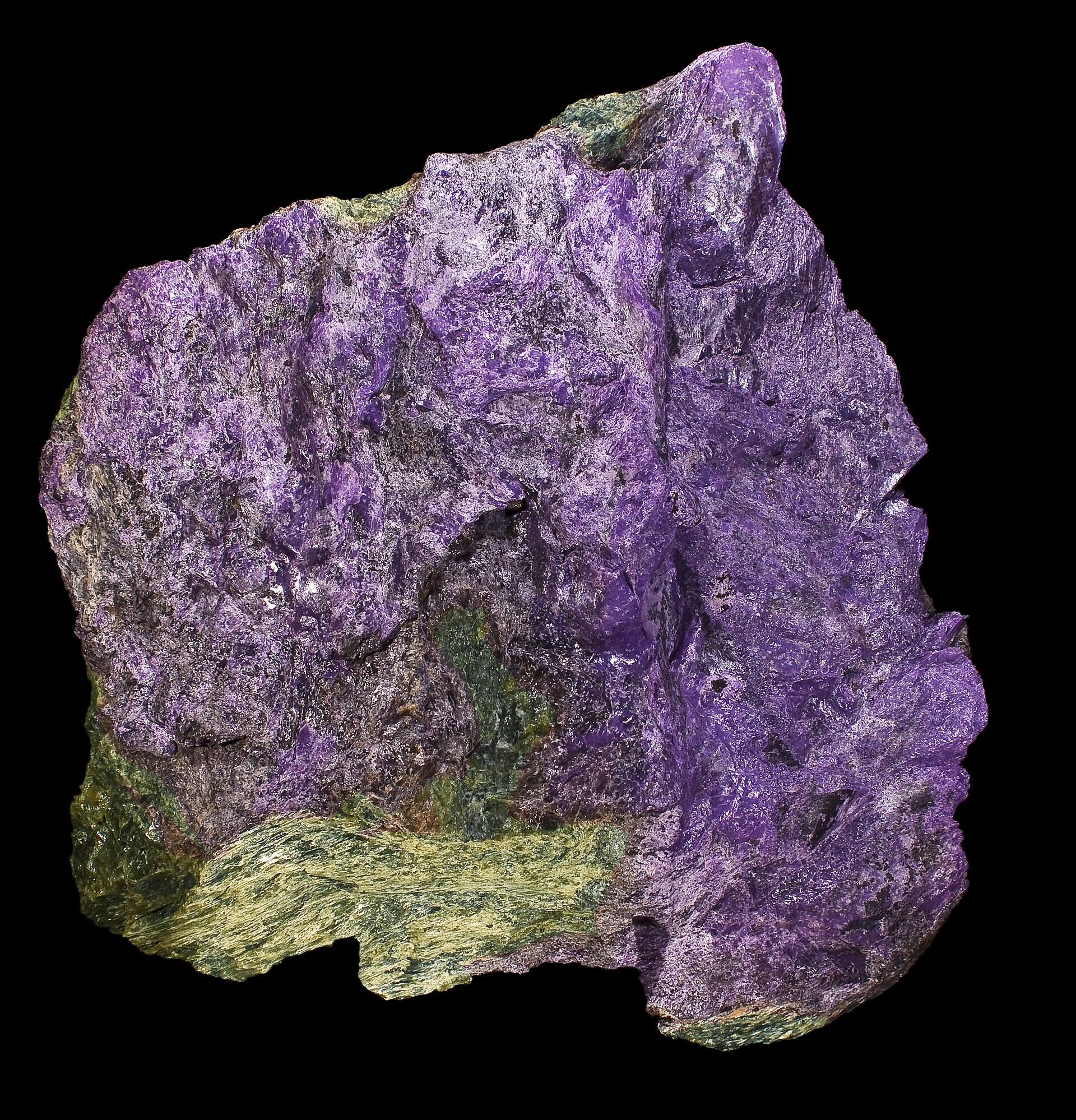
Stichtite and lizardite Locality: Stichtite Hill, Dundas mineral field, Zeehan District, Tasmania, Australia Size :15 × 14 cm. — Photo: Didier Descouens · CC BY 3.0
Lizardite
Also known as: Serpentine.
The most common serpentine-group mineral — a magnesium phyllosilicate, the non-fibrous form of 'serpentine'.
Intro adapted from Wikipedia (CC BY-SA).
Lizardite is an IMA-recognized mineral species in the silicate class, with the chemical formula Mg₃Si₂O₅(OH)₄.
It crystallizes in the hexagonal crystal system (space group P6_3cm). It is a member of the Serpentine, Clay structural group.
Key properties: Mohs hardness 2.5; specific gravity 2.55; typically green or yellow or white; white streak; Waxy luster; refractive index 1.629; optically uniaxial.
IMA symbol Lz, grandfathered status — known before the IMA’s founding, named in 1956.
Typically a product of retrograde metamorphism, replacing olivine, orthopyroxene, or other minerals in ultramafic igneous rocks.
It is found associated with Chrysotile, brucite, magnetite.
The name is taken from the type locality, the Lizard complex, Cornwall, England.
Collections: Everyday Minerals, Collector Favorites.