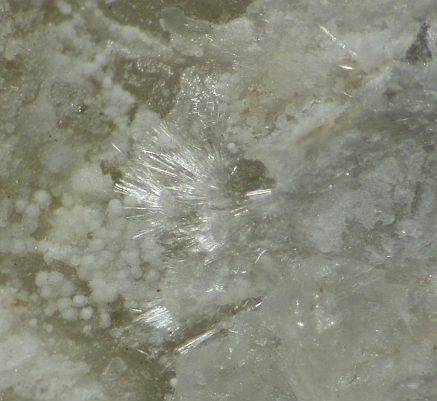
White sprays of Macdonaldite (Field of view 4 mm) Locality: Rush Creek, Rush Creek deposit, Big Creek-Rush Creek District, Fresno County, California, USA ( Locality at mindat.org ) Blue botryoidal crust of McGuinnessite. Field of view 6 mm. Specimen and photo Leon Hupperichs. — Photo: Leon Hupperichs · CC BY-SA 3.0
Macdonaldite
A rare barium-calcium silicate hydrate named in 1965 for Hawaiian volcanologist Gordon Macdonald.
Intro adapted from Wikipedia (CC BY-SA).
Macdonaldite is an IMA-recognized mineral species in the silicate class, with the chemical formula BaCa₄Si₁₆O₃₆(OH)₂·10H₂O.
It crystallizes in the orthorhombic crystal system (space group Bmmb). It is a member of the Rhodesite structural group.
Key properties: Mohs hardness 3.5–4; specific gravity 2.27; White streak; Satiny to vitreous luster; refractive index 1.524; optically biaxial.
IMA symbol Mcd, IMA status: approved, named in 1964.
Occurs as veinlets, fracture coatings, and disseminated in a sanbornite-quartz-bearing metamorphic rock.
It is found associated with Sanbornite, quartz.
The name refers to Gordon Andrew MacDonald (1911–1978), American vulcanologist, University of Hawaii, Honolulu, Hawaii, USA.