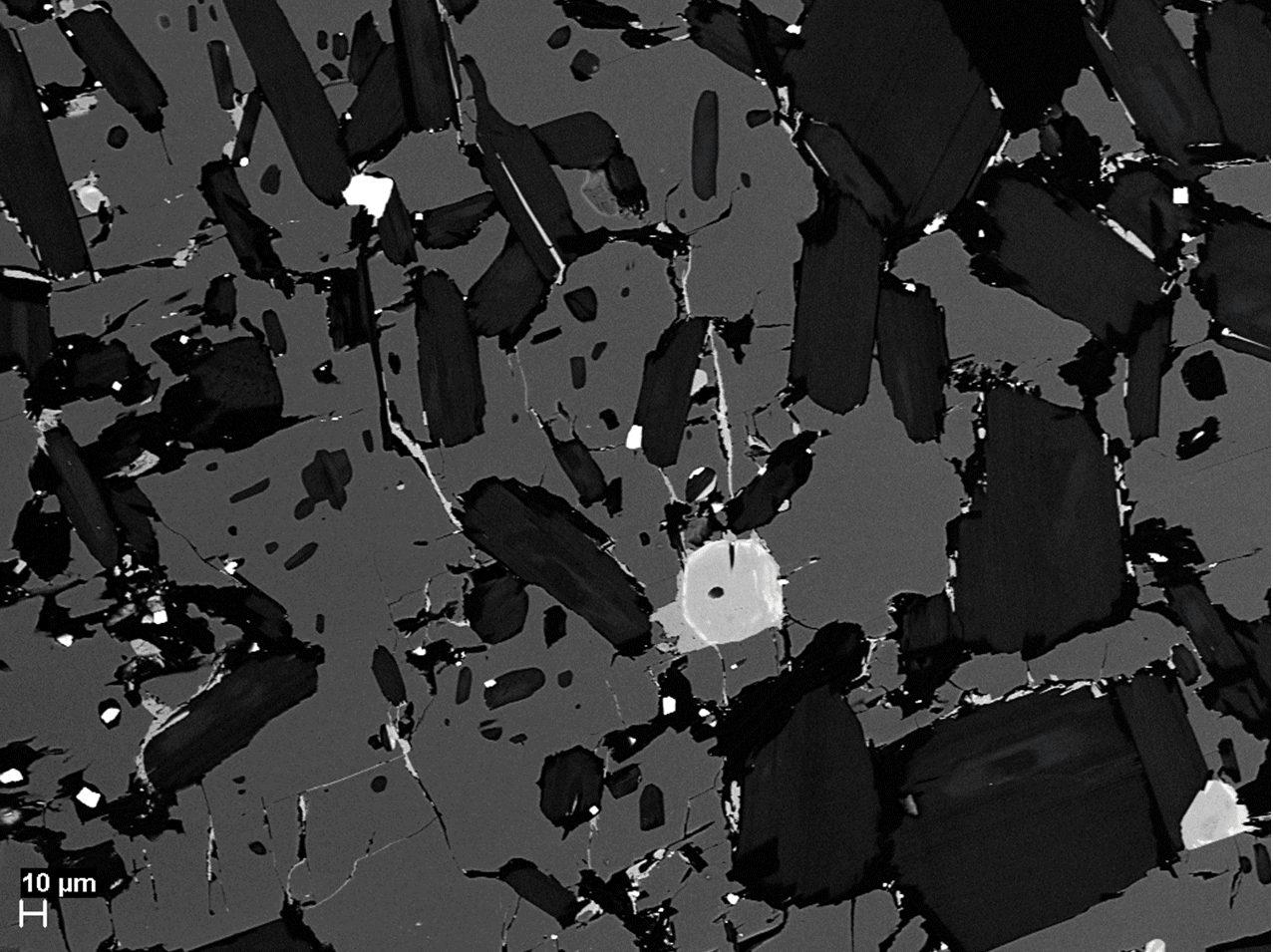
(a) Image in plane-polarised reflected light of a subhedral skogbyite crystal with a hexagonal-like outline (centre) included in poikiloblastic pinakiolite. Vague zoning can be seen in the skogbyite. Fracture fillings in the host pinakiolite partly contain Fe–Mn oxides. The scale bar equals 50 µm. (b) High-contrast back-scattered electron (BSE) image showing subhedral skogbyite crystals (medium to light grey with lighter, mainly outer, zones showing Pb enrichment in the centre and lower right) included in poikiloblastic pinakiolite (dark-grey groundmass). The BSE light to BSE white fracture fillings and irregular larger grains are Fe–Mn oxides, while BSE white crystals with a square outline are macedonite. Elongated black inclusions in the pinakiolite are subhedral crystals or aggregates of phlogopite. The scale bar equals 10 µm. — Photo: Erik Jonsson, Ulf Hålenius, Jaroslaw Majka, and Ferdinando Bosi · CC BY 4.0
Macedonite
Lead titanate — a tetragonal oxide named in 1971 for its occurrence near Prilep, North Macedonia.
Intro adapted from Wikipedia (CC BY-SA).
Macedonite is an IMA-recognized mineral species in the oxides & hydroxide class, with the chemical formula PbTiO₃.
It crystallizes in the tetragonal crystal system (space group Pmmm). It is a member of the Perovskite structural group.
Key properties: Mohs hardness 5.5–6; specific gravity 7.82; Vitreous luster.
IMA symbol Mce, IMA status: approved, named in 1970.
Found as a rare accessory mineral in microcline-quartz syenite pegmatite veins cutting pyroxene amphibole schist (Crni Kamen, Macedonia); as inclusions in hematite and magnetoplumbite in a metamorphosed Fe–Mn orebody (Långban, Sweden).
It is found associated with Microcline, quartz, aegirine, arfvedsonite, rutile, zircon (Crni Kamen, Macedonia); hematite, magnetoplumbite, manganoan phlogopite, calcian mimetite.
The name refers to Macedonia, where the mineral was discovered.