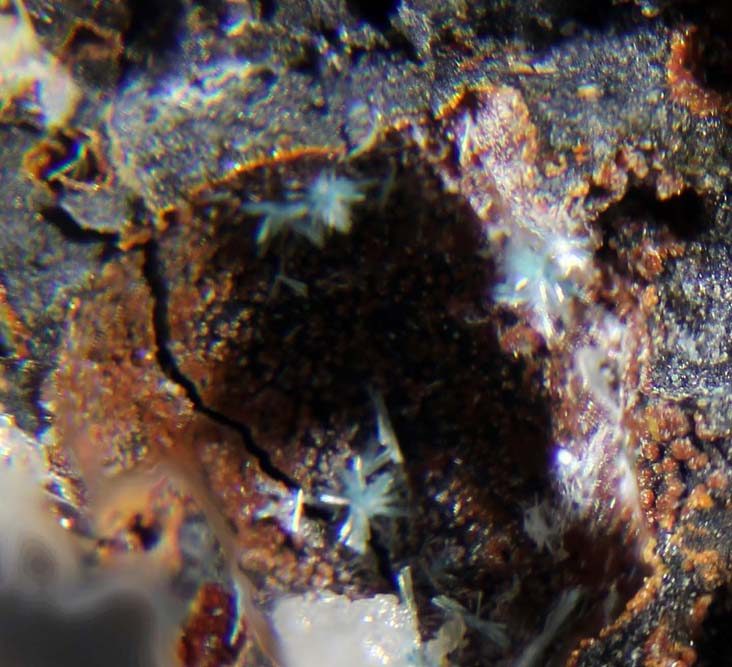
Sky blue acicular crystals of mammothite in a specimen from the famous Lavrion deposit (Attica, Greece). — Photo: David Hospital · CC BY-SA 4.0
Mammothite
A lead-copper-aluminium sulfate from Arizona's Mammoth mine at Tiger — and Laurium, Greece.
Intro adapted from Wikipedia (CC BY-SA).
Mammothite is an IMA-recognized mineral species in the sulfate class, with the chemical formula Pb₆Cu₄AlSb⁵⁺O₂(SO₄)₂Cl₄(OH)₁₆.
It crystallizes in the monoclinic crystal system (space group C2/m).
Key properties: Mohs hardness 3; specific gravity 4.2; Pale blue streak; Vitreous luster; optically biaxial.
IMA symbol Mm, IMA status: approved, named in 1983.
A rare secondary mineral found in the oxidized zone of a hydrothermal polymetallic base-metal deposit (Tiger, Arizona, USA); in metallic slag, formed by reaction with ocean water (Laurium, Greece).
It is found associated with Anglesite, leadhillite, caledonite, phosgenite, diaboleite, wulfenite (Tiger, Arizona, USA); cerussite, matlockite, laurionite, paralaurionite, phosgenite.
The name refers to the Mammoth vein at Tiger, Arizona, from where the mineral was first noted, and the town of Mammoth, Arizona, USA, named for the mine.