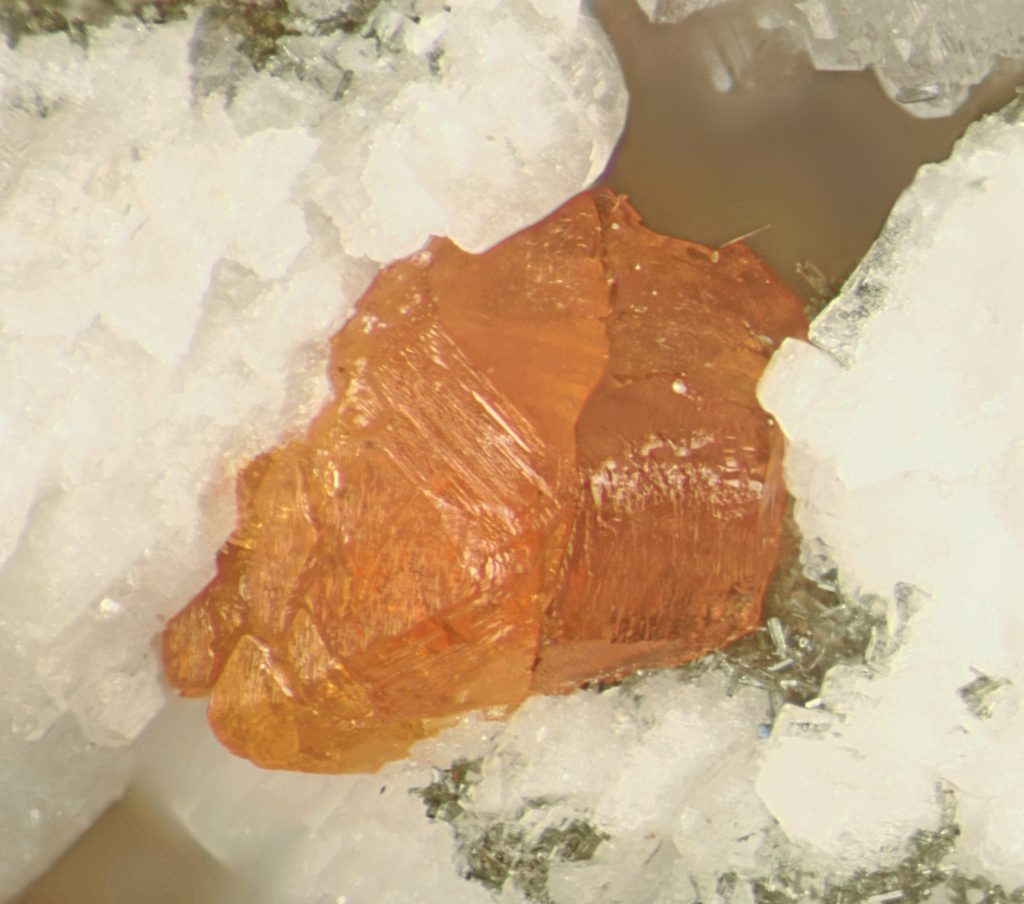
FOV 2.8 x 2.4 mm. Found August 1997 (Poudrette quarry, Mont Saint-Hilaire, La Vallée-du-Richelieu RCM, Montérégie, Québec, Canada). MOB coll. This somewhat crude xl is on a specimen analyzed at CMN. This find (in igneous breccia) produced ferrokentbrooksite ( http://www.mindat.org/photo-166795.html ), manganokhomyakovite and khomyakovite ( http://www.mindat.org/photo-166793.html ). (According to Pavel Kartashov, there may be other, undescribed, eudialyte group members as well.) But the xls are generally zoned. The analysis for this specimen showed a core of ferrokentbrooksite with a shell of manganokhomyakovite. However this particular xl may have a different structure. It is impossible to distinguish eudialyte group members visually at MSH. For this particular occurence I estimate that ferrokentbrooksite >> manganokhomyakovite > khomyakovite. But this is based on just 7-8 analyses that I know of — Photo: Modris Baum · CC0
Manganokhomyakovite
A very rare manganese-dominant relative of khomyakovite in the eudialyte group.
Intro adapted from Wikipedia (CC BY-SA).
Manganokhomyakovite is an IMA-recognized mineral species in the silicate class, with the chemical formula Na₁₂Sr₃Ca₆Mn₃Zr₃W(Si₂₅O₇₃)(O,OH,H₂O)₃(Cl,OH)₂.
It crystallizes in the hexagonal crystal system (space group R3m). It is a member of the Eudialyte structural group.
Key properties: Mohs hardness 5–6; specific gravity 3.13; White streak; Vitreous luster; optically uniaxial.
IMA symbol Mkmy, IMA status: approved, named in 1998.
Found in miarolitic cavities in nepheline syenite in an alkaline intrusive complex.
It is found associated with Aegirine, albite, analcime, annite, cerussite, galena, kupletskite, microcline, molybdenite, natrolite, pyrite, pyrrhotite, sodalite, sphalerite, titanite.
The mineral was named to honor Dr. Alexander Petrovich Khomyakov (b. 1933), of the Institute of Mineralogy, Geochemistry and Crystal Chemistry of Rare Elements, Moscow, Russia.