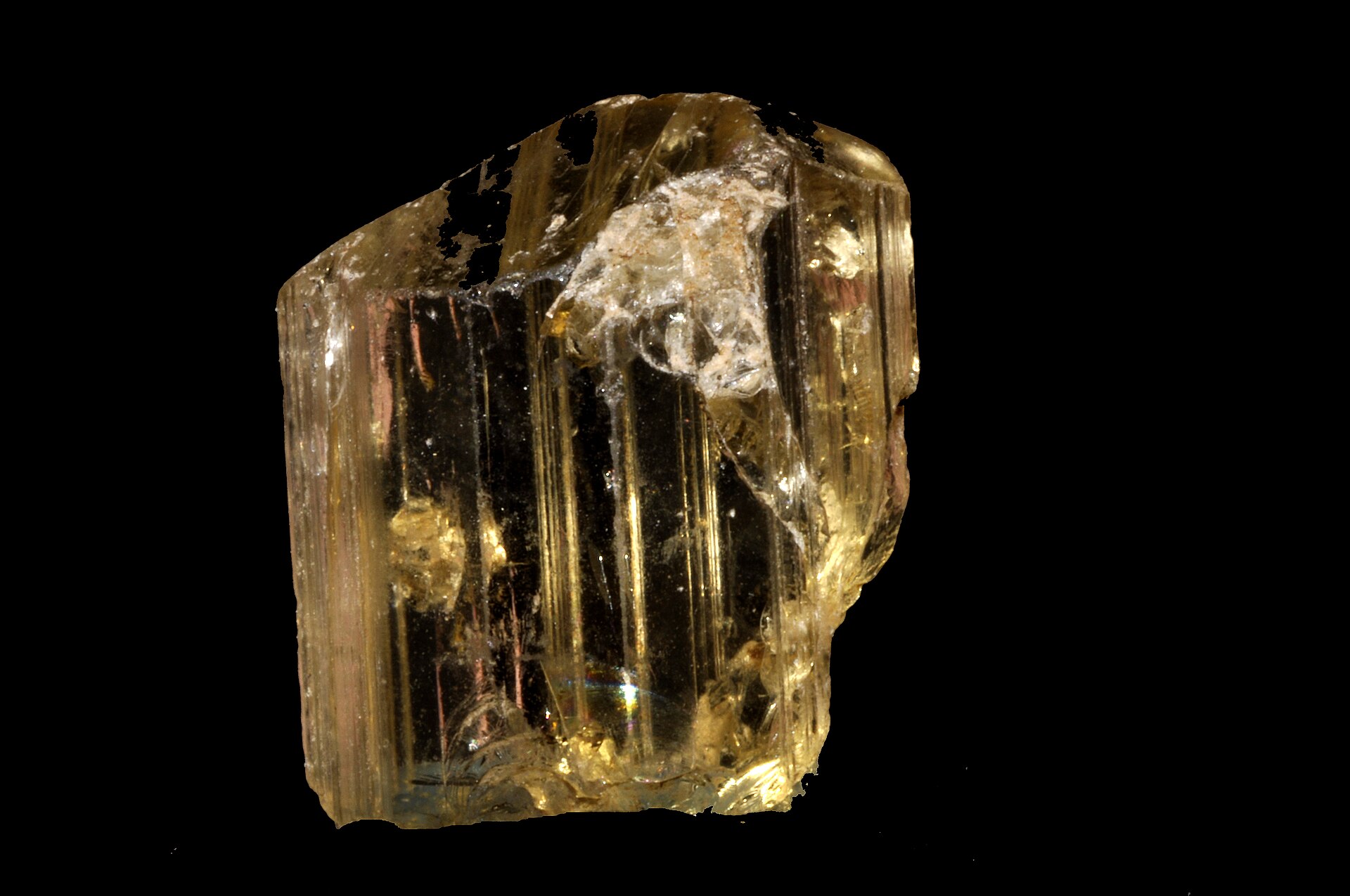
scapolite var. marialite : Rubeho Mts, Mpapwa, Mpapwa (Mpwampwa) District, Dodoma Region, Tanzania — Photo: Géry PARENT · Public domain
Marialite
The sodium end-member of the scapolite series — a chloride-bearing tectosilicate of skarns and regional metamorphic rocks.
Intro adapted from Wikipedia (CC BY-SA).
Marialite is an IMA-recognized mineral species in the silicate class, with the chemical formula Na₄Al₃Si₉O₂₄Cl.
It crystallizes in the tetragonal crystal system (space group I4/m). It is a member of the Scapolite structural group.
Key properties: Mohs hardness 5.5–6; specific gravity 2.5–2.62; typically colorless or white or gray or yellow; White streak; Vitreous, pearly, resinous luster; refractive index 1.541; optically uniaxial.
IMA symbol Mar, grandfathered status — known before the IMA’s founding, named in 1866.
is typically found in regionally metamorphosed rocks, especially marbles, calcareous gneisses, granulites, and greenschists. Also in skarns, some pegmatites, pneumatolytically or hydrothermally altered mafic igneous rocks.
It is found associated with Plagioclase, garnet, pyroxenes, amphiboles, apatite, titanite, zircon.
The name refers to Maria Rosa vom Rath, wife of Gerhard vom Rath, German mineralogist, who named the species.
Collections: Collector Favorites.