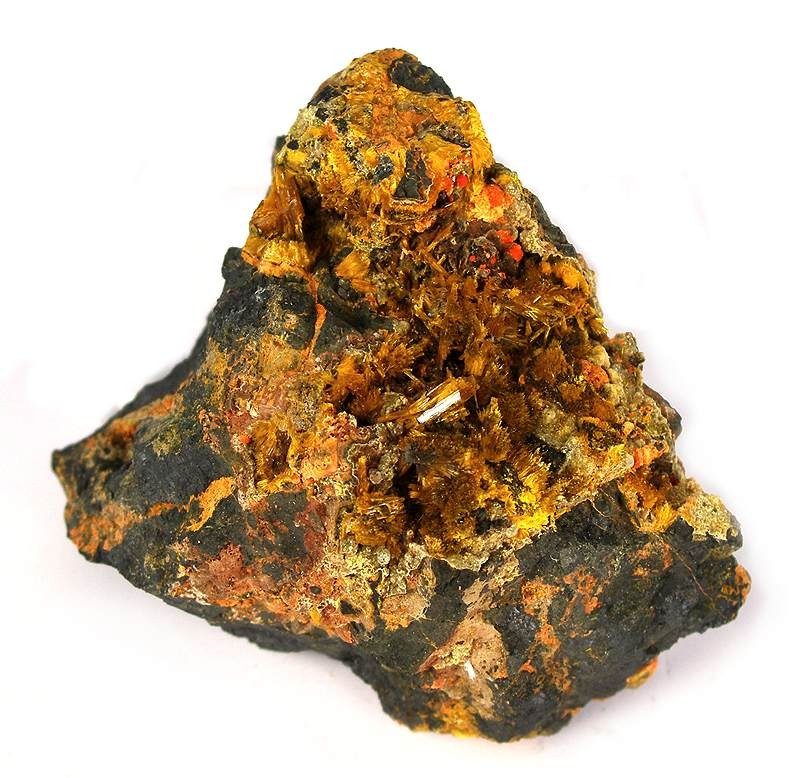
Becquerelite , Masuyite , Fourmarierite , Uranophane - alpha Locality: Shinkolobwe Mine (Kasolo Mine), Shinkolobwe , Central area, Katanga Copper Crescent, Katanga (Shaba) , Democratic Republic of Congo (Zaïre) ( Locality at mindat.org ) Size: 6.2 x 5.8 x 3.1 cm. This large, rich specimen has three species for which this is the type locality: Masuyite (in red spherical aggregates), Fourmarierite (dark red/umber crystals underlying the Becquerelite and embedded in the matrix), and superb, large sprays of Becquerelite with crystals to a whopping 5mm. The matrix is uraninite. — Photo: Robert M. Lavinsky · CC BY-SA 3.0
Masuyite
A lead-uranyl oxide described in 1947 from Katanga, named for Belgian geologist Gustave Masuy.
Intro adapted from Wikipedia (CC BY-SA).
Masuyite is an IMA-recognized mineral species in the oxides & hydroxide class, with the chemical formula Pb(UO₂)₃O₃(OH)₂·3H₂O.
It crystallizes in the monoclinic crystal system (space group Pn).
Key properties: specific gravity 5.08; refractive index 1.865; optically biaxial.
IMA symbol Msy, grandfathered status — known before the IMA’s founding, named in 1947.
A secondary mineral formed in the oxidized zone of uranium-bearing deposits.
It is found associated with Uraninite, rutherfordine, becquerelite, fourmarierite, wyartite, wölsendorfite, kasolite, metastudtite.
The name refers to Gustave Masuy (1905–1945), Belgian geologist, who studied Congolese (Zairian) minerals.