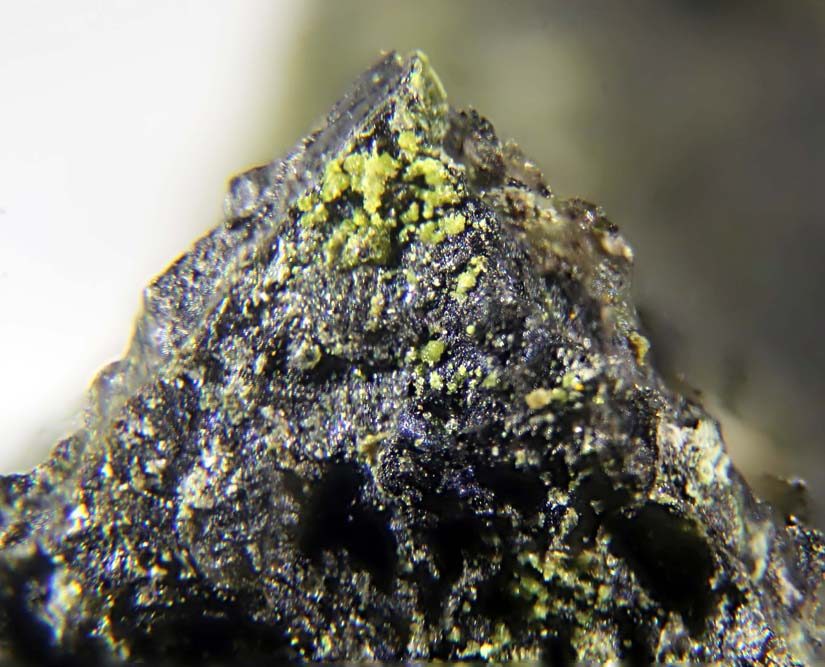
Yellow microcrystals of the extremely rare uranium mineral mathesiusite (IMA 2013-046) from one of the only two known localities worldwide: North Mesa Mine group, Temple Mountain, Emery County, Utah, United States of America. Analyzed by SEM/EDS. — Photo: David Hospital · CC BY-SA 4.0
Mathesiusite
A rare potassium uranyl sulfate-vanadate formed on mine dumps after mining ends.
Intro adapted from Wikipedia (CC BY-SA).
Mathesiusite is an IMA-recognized mineral species in the vanadate class, with the chemical formula K₅(UO₂)₄(SO₄)₄(VO₅)(H₂O)₄.
It crystallizes in the tetragonal crystal system (space group P4/n). It is a member of the Mathesiusite structural group.
Key properties: Mohs hardness 2; specific gravity 4.018; Greenish white streak; Vitreous luster; optically uniaxial.
IMA symbol Mhe, IMA status: approved, named in 2013.
A rare post-mining, secondary mineral in the underground workings in a polymetallic hydrothermal vein type deposit.
It is found associated with Adolfpateraite, schoepite, čejkaite, zippeite, gypsum.
The mineral was named to honor Johannes Mathesius (1504-1565), Lutheran priest and theologian. Mathesius lived and served in Jáchymov, first as a teacher at the Latin lyceum, then as a pastor.