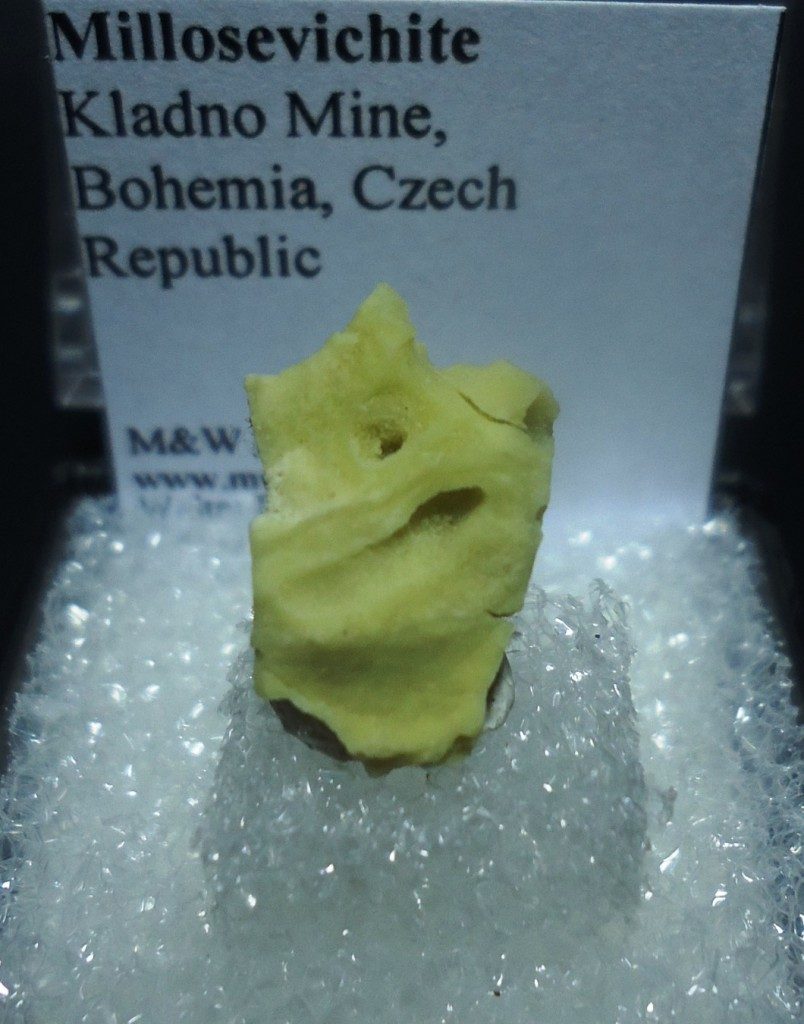
Locality: Kladno Mine (Nejedlý I Mine; Zdeněk Nejedlý Mine; Schoeller Mine; Schöller Mine), Libušin, Kladno, Central Bohemia Region, Bohemia (Böhmen; Boehmen), Czech Republic Dimensions: 14 mm x 10 mm x 8 mm Porous yellow Millosevichite; Photo and collection Fernando Brederodes. — Photo: Fernando Brederodes · CC0
Millosevichite
A rare anhydrous aluminium sulfate forming porous masses — described in 1913 from Vulcano Island, Sicily.
Intro adapted from Wikipedia (CC BY-SA).
Millosevichite is an IMA-recognized mineral species in the sulfate class, with the chemical formula Al₂(SO₄)₃.
It crystallizes in the hexagonal crystal system (space group R-3). It is a member of the Millosevichite structural group.
Key properties: Mohs hardness 1.5; specific gravity 1.72; Red streak; Vitreous luster; refractive index 1.508; optically uniaxial.
IMA symbol Msv, grandfathered status — known before the IMA’s founding, named in 1913.
Precipitated at high temperature from gasses originating from solfataric activity or burning coal measures.
It is found associated with Sulfur, sal ammoniac, letovicite, alunogen, boussingaultite (Kladno, Czech Republic).
The mineral was named to honor Professor Federico Millosevich (1875–1942), Italian mineralogist, University of Rome, Rome, Italy.