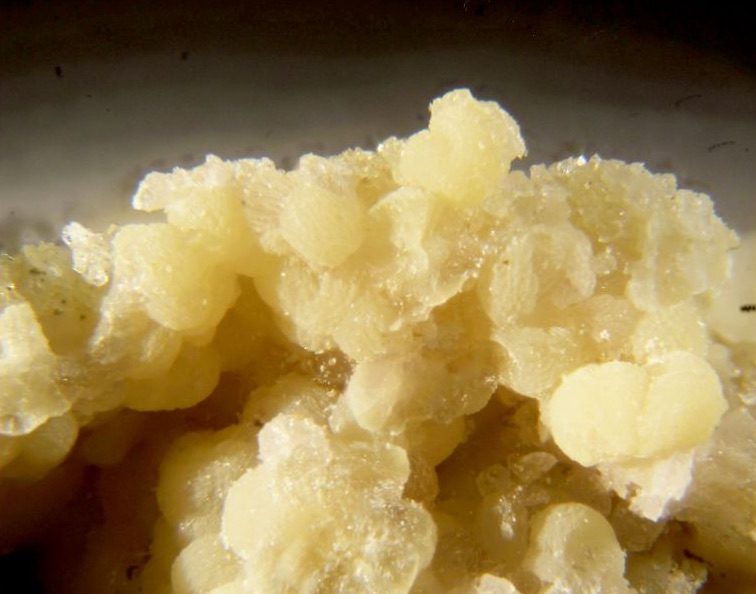
Pale yellow globular aggregates of the rare phosphate mineral millisite from: Fairfield, Utah County, Utah, United States of America. Ex Vandenbroucke Museum collection from Waregem, Belgium. — Photo: David Hospital · CC BY-SA 4.0
Millisite
A rare sodium-calcium aluminium phosphate named for F. T. Millis of Lehi, Utah, found in altered phosphate deposits.
Intro adapted from Wikipedia (CC BY-SA).
Millisite is an IMA-recognized mineral species in the phosphate class, with the chemical formula NaCaAl₆(PO₄)₄(OH)₉·3H₂O.
It is a member of the Wardite structural group.
Key properties: Vitreous luster; optically biaxial.
IMA symbol Mill, grandfathered status — known before the IMA’s founding, named in 1930.
Occurs as finely banded crusts on variscite nodules (Little Green Monster mine, Utah, USA); in phosphatic laterite (Taiba mine, Senegal); as cement in weathered phosphorite (Homeland mine, Florida, USA).
It is found associated with Wardite, apatite, crandallite (Little Green Monster mine, Utah, USA); crandallite, augelite, wavellite, turquoise (Taiba mine, Senegal); crandallite.
The mineral was named to honor F.T. Millis, of Lehi, Utah, USA, who collected the first specimens. Type Material: n.d.