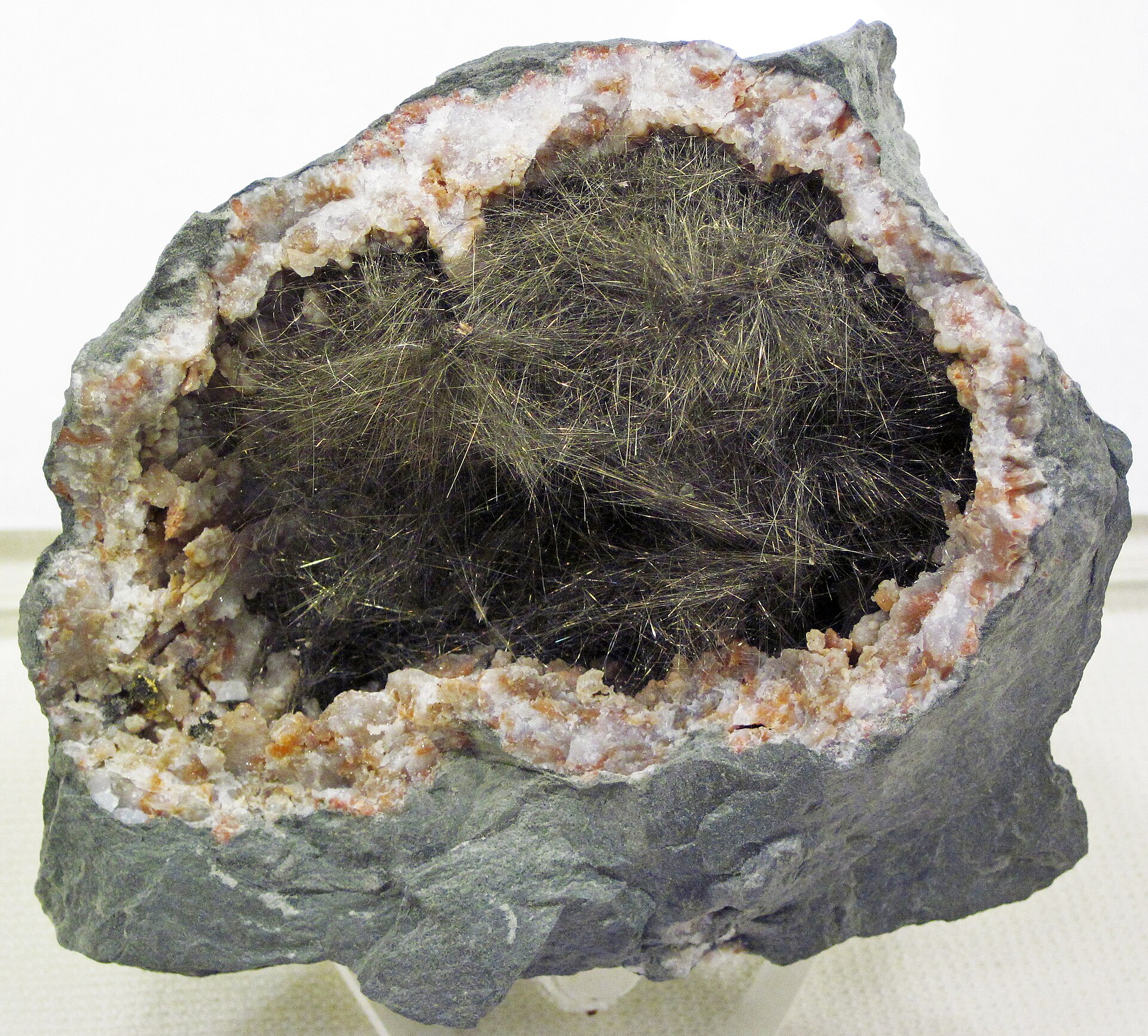
Millerite in a geode from Kentucky, USA. A mineral is a naturally-occurring, solid, inorganic, crystalline substance having a fairly definite chemical compositi — Photo: James St. John · CC BY 2.0
Millerite
Also known as: Capillary pyrites.
Nickel sulfide — 'nickel blende' — brassy acicular needles forming radiating 'furry' aggregates.
Intro adapted from Wikipedia (CC BY-SA).
Millerite is an IMA-recognized mineral species in the sulfide class, with the chemical formula NiS.
It crystallizes in the hexagonal crystal system (space group P6_3/mmc). It is a member of the Millerite structural group.
Key properties: Mohs hardness 3–3.5; specific gravity 5.5; typically yellow; Greenish black streak; Metallic luster.
IMA symbol Mlr, grandfathered status — known before the IMA’s founding, named in 1845.
Most commonly as a low-temperature mineral, in cavities in limestones and carbonate veins and in barite; an alteration product of other nickel minerals; also in sedimentary rocks, in association with coal measures.
It is found associated with Gersdorffite, polydymite, nickeline, galena, sphalerite, pyrite, chalcopyrite, pyrrhotite, pentlandite, cubanite, calcite, dolomite, siderite, barite, ankerite.
The mineral was named to honor William Hallowes Miller (1801–1880), British mineralogist, Cambridge University, Cambridge, England, who first studied crystals of the mineral.
Collections: Metals & Native Elements, Collector Favorites.