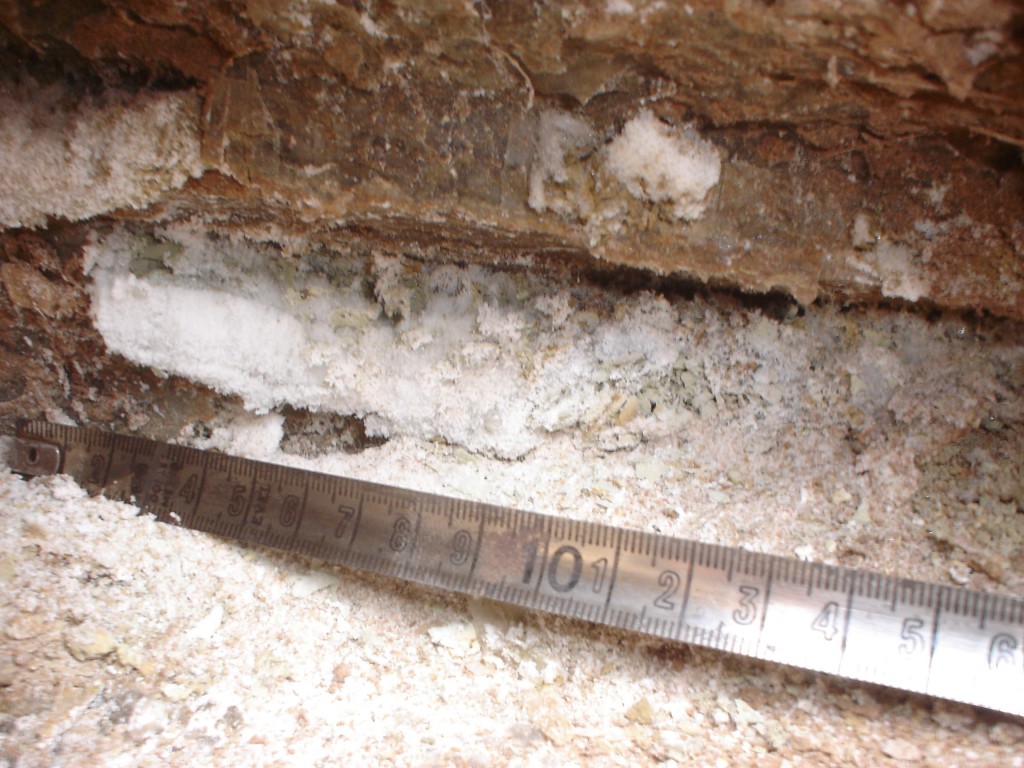
Mirabilite, Gypsum (Size: 18 x 4 cm) Locality: Vipos, Trancas Department, Tucumán, Argentina Original description: Vein of Mirabilite well Crystallized in Gypsu — Photo: Raúl Jorge Tauber Larry · Public domain
Mirabilite
Also known as: Glauber's salt.
Glauber's salt — hydrated sodium sulfate forming colorless crystals in salt lakes; it readily dehydrates to thenardite.
Intro adapted from Wikipedia (CC BY-SA).
Mirabilite is an IMA-recognized mineral species in the sulfate class, with the chemical formula Na₂(SO₄)·10H₂O.
It crystallizes in the monoclinic crystal system (space group P2_1/c).
Key properties: Mohs hardness 1.5–2; specific gravity 1.464; typically white or colorless or yellow; White streak; Vitreous luster; refractive index 1.408; optically biaxial.
IMA symbol Mrb, grandfathered status — known before the IMA’s founding, named in 1845.
is typically found in salt pans, playas, and saline lakes, where deposition may be seasonal, and bedded deposits formed therefrom; rarely in caves and lava tubes; in volcanic fumaroles; a product of hydrothermal sericitic alteration.
It is found associated with Gypsum, thénardite, halite, trona, glauberite, aphthitalite, blödite, epsomite.
The name comes from the Latin sal mirable, for miracle salt, expressing Glauber’s surprise on its synthesis.
Collections: Everyday Minerals.