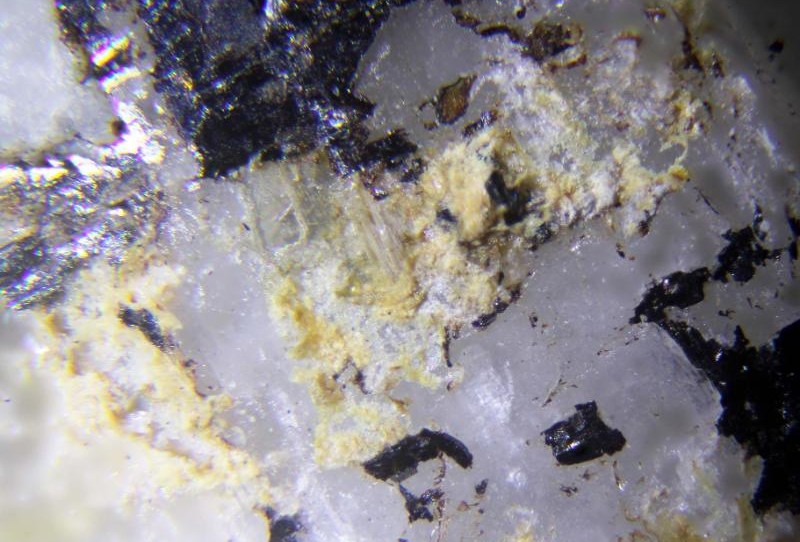
Orange crystal aggregates of the rare member of the monazite group, monazite-(La), from Lovozero, Russia (Pegmatite #47, Lepkhe-Nel'm Mountain, Seidozero Lake, — Photo: David Hospital · CC BY 4.0
Monazite-(Ce)
Also known as: Monazite.
Monazite-(Ce) (CePO4) is the most common representative of the monazite group. It is the cerium-dominant analogue of monazite-(La), monazite-(Nd), and monazite-(Sm). It is also the phosphorus analogue of gasparite-(Ce). The group contains simple rare earth phosphate minerals with the general formula of AXO4, where A = Ce, La, Nd, or Sm (or, rarely, Bi), and X = P or, rarely, As. The A site may also bear Ca and Th.
Intro adapted from Wikipedia (CC BY-SA).
Monazite-(Ce) is an IMA-recognized mineral species in the phosphate class, with the chemical formula Ce(PO₄).
It crystallizes in the monoclinic crystal system (space group P2_1/n). It is a member of the Monazite structural group.
Key properties: Mohs hardness 5–5.5; specific gravity 4.98–5.43; typically brown or red or yellow or orange or pink; white streak; Resinous, waxy, vitreous to adamantine luster; optically biaxial.
IMA symbol Mnz-Ce, IMA status: approved, named in 1829.
An accessory mineral in granites, syenites, and their pegmatites; in carbonatites and volcanoclastic rocks; in fissure veins and high-grade metamorphic rocks; commonly detrital in river and beach sands.
It is found associated with Zircon, xenotime, titanite, thorite, allanite, columbite, wolframite (pegmatites and Alpine fissures); rhabdophane, cerianite, florencite, churchite (Mt. Weld.
Its name comes from the Greek for solitary, for its initial apparent rarity, and dominant cerium.
Collections: Collector Favorites, Rare & Remarkable.